


Implementing a general contractor early pay program can transform GC operations, unlocking a new revenue stream and significantly improving project margins. But without a clear strategy and disciplined execution, these programs can fall short of their potential. Thoughtful planning, careful setup, and consistent follow-through are essential to success.
This series explores the key factors behind successful GC early pay program deployment, beginning with the most critical step: defining clear objectives and establishing the right timing early in the process.
Table of Contents
The Importance of Defining Your Objectives and Timing
In construction, many early pay programs have been launched with good intent but have yielded uneven results. The issue is not whether early pay programs work; it is whether the organization clearly defined what it was trying to achieve and how success would be measured.
Without clear objectives and timing, programs often drift, adoption stalls, and leadership struggles to determine whether the program is succeeding or falling short. Too often, underperformance leads organizations to question early pay as a concept rather than to take a hard look at how the program was deployed against their objectives.
Defining Success Starts With the Objective
For many general contractors, a primary objective of an early pay program is to generate incremental margin or financial return. In these cases, subcontractor participation is not the goal itself; it is the mechanism through which the financial objective is achieved.
If margin is the objective, success is often measured by adoption, defined as the percentage of subcontractor spend paid early through the program. A certain level of subcontractor adoption is required to achieve a specific return, and overlooking adoption can put the entire program at risk.
For example: If the financial goal is modest, a lower level of adoption may be sufficient. If the financial goal is more aggressive, significantly higher adoption will be required.
In this context, adoption is a leading indicator. If adoption is lower than planned, the margin objective will not be met. If adoption exceeds expectations, the program may outperform its financial targets.
How to Consider Multiple Objectives
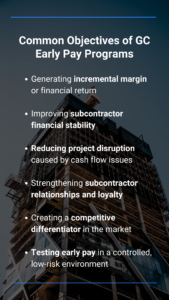
While generating incremental margin or return is a common objective, it is not the only reason general contractors deploy early pay programs. Many organizations pursue GC early pay for a combination of strategic, operational, and financial reasons.
More mature programs often have multiple objectives. However, those objectives must be clearly articulated and—where possible—prioritized. Without clarity, teams struggle to align program design, internal training and messaging, subcontractor messaging, funding decisions, and internal expectations.
The most successful programs are intentional about their objectives and recognize that different objectives require different measures of success. Once an objective or multiple objectives are established, the next area of focus is the early pay program’s timing.
Why Timing Creates Accountability and Focus
Objectives without timing lack urgency because timing matters just as much as the objective itself. Timing sets expectations internally and externally. A program designed as a slow pilot behaves very differently from one expected to be fully operational with all subcontractors onboarded within 180 days.
Clear timing influences:
- Executive sponsorship and engagement
- Internal prioritization and resourcing
- Subcontractor engagement strategies
- Partner accountability
- Measurement cadence
Timing also creates checkpoints. Leadership can assess whether the program is on track, behind schedule, or exceeding expectations and adjust accordingly. Understanding this cause-and-effect relationship early is critical. Without it, organizations may mistake activity for success or misjudge whether the program is delivering value.
Accurate Measurement Depends on the Objective
Once objectives and timing are clearly defined, measurement becomes straightforward.
- If margin or return is the primary objective, success is often measured by subcontractor adoption, typically defined as the percentage of subcontractor spend paid early through the program. Adoption is the mechanism through which financial outcomes are achieved, not the objective itself.
- If the objective is subcontractor financial stability, measurement may focus on participation across key trades, smaller subcontractors, or repeat usage over time.
- If the objective is risk reduction or project continuity, measurement may emphasize participation in critical path trades or reductions in payment-related disruptions.
- If the objective is learning or readiness, success may be measured by execution milestones, onboarding completion, or qualitative feedback rather than scale.
Problems arise when organizations attempt to measure success without first aligning on objectives. In those cases, teams often track what is easiest to measure rather than what reflects true program performance.
Clear measurement frameworks do more than report results. They inform decisions about whether to adjust funding levels, refine subcontractor outreach, accelerate rollout, or reconsider program design.
Who Needs to Be Involved in Setting Objectives
Successful early pay programs are shaped by both leadership and the teams closest to the work. Executive leadership needs to set direction, define priorities, and align the program with broader financial and strategic goals. Their sponsorship ensures the program has the authority and attention required to move forward.
At the same time, the teams responsible for executing payments, approving invoices, and managing subcontractor relationships must be involved early. These teams understand the practical realities of the business and can identify constraints that directly affect program success.
For example, if subcontractors are currently paid by check, transitioning to electronic payments may be a prerequisite for adoption to meet the objectives. That transition raises important questions: Is the organization aligned with making this change? If we don’t change, what is the effect on the program? What is the timeline? Can it be done in parallel with an early pay rollout, or must it occur first? Can the vendor assist in this change?
These operational realities directly influence objectives and timing. Ignoring them can result in unrealistic expectations or avoidable delays.
Why Priority and Ownership Matter
How an organization treats an early pay program at the outset often determines the results it delivers. If early pay is positioned as a small initiative, given low priority, limited resources, and minimal leadership attention, it will produce low-priority results. Adoption will be slow, momentum will stall, and outcomes will fall short of expectations. This is not a failure of the concept. It reflects how the program was positioned internally.
Establishing objectives is not just about defining outcomes. It is also about signaling importance. The level of urgency, visibility, and resourcing attached to the program will directly influence how teams engage and how subcontractors respond.
The Importance of Alignment Before Execution
Objective setting should be a collaborative process. Leadership sets the ambition and operational teams test feasibility based on how the business actually runs. Through this dialogue, a common ground should be reached.
Key questions that can help create alignment often include:
- What changes are required to support early pay?
- Are those changes acceptable and achievable?
- What is the realistic timing of those changes?
- How does that timing affect program goals?
- What support can we receive from our partners?
A well-chosen partner should guide these discussions, drawing on experience from similar implementations and helping teams understand trade-offs. This guidance is especially valuable when changes such as payment modernization or process redesign are involved.
Having the right people involved early creates alignment, reduces friction later, and increases the likelihood that objectives are both ambitious and achievable.
What to Consider When Selecting a Partner
Clear objectives and timing are essential inputs to selecting the right implementation partner because not all providers are built to support the same goals. Some are optimized for controlled rollouts while others are designed for speed, scale, and high adoption. Some bring deep subcontractor enablement experience and others focus primarily on technology.
A strong partner should be able to explain how their methodology supports your specific objectives and timeline, not just how their platform works. They should bring recommendations based on experience with similar general contractors and be willing to challenge assumptions when needed.
Early pay programs often run for 10 years or more and become embedded in payment workflows. Misalignment at the beginning can lead to slow adoption, unmet expectations, and unnecessary course correction.
Why You Should Partner With an Expert
Most organizations have not previously selected or deployed an early pay program. While teams may have experience implementing other financial or technology solutions, early pay programs are typically new to them as they sit at the intersection of finance, operations, subcontractor relationships, and risk management.
Providers who have implemented these programs across similar organizations bring experience that internal teams lack. Their guidance should be evaluated thoughtfully, not dismissed because it feels unfamiliar.
It is important to note that it isn’t mandatory to implement every recommendation. Nevertheless, all decisions should be grounded in alignment with the stated objectives and timeline, rather than in potentially misguided internal beliefs and assumptions.
Setting the Foundation for Successful Implementation
Defining objectives and timing is not a formality. It is the foundation of a successful early pay program.
Organizations that invest time here move faster later, measure success more accurately, select better partners, and avoid common pitfalls. Those who don’t put in the initial investment often spend more time course-correcting, getting mixed results, and questioning the solution.
After aligning on a GC early pay program’s objectives and timing, the next consideration for general contractors is how to decide on funding strategies. In the next part of our series, we’ll explore how to decide between a third-party-funded or a self-funded program while evaluating the pros and cons for each type of program.