


Before general contractors decide to implement their own early pay programs, they need to identify the program’s objective, select a funding strategy, develop a plan for subcontractor adoption, and establish clear and consistent processes around invoice processing. The final step to take when implementing a new early pay program is to decide on a partner for the program because selecting the right partner is a critical factor in the long-term success of an early pay program.
Before evaluating providers, general contractors should first consider a fundamental decision: whether to build the program internally or partner with a specialist.
Table of Contents
Deciding Whether to Build or Partner
General contractors can operate an early pay program internally and retain the full early payment discount, or partner with a third party to share a portion of the economics. The decision ultimately comes down to whether the additional return from running the program internally offsets the operational effort required to launch and manage it.
This ties directly back to the early pay program’s objectives. If the objective is modest, such as offering occasional early payments where incremental returns are sufficient, a self-managed approach may work. However, if the goal is meaningful subcontractor adoption and a scalable financial outcome, general contractors must consider whether they have the time, personnel, and expertise required to operate the program.
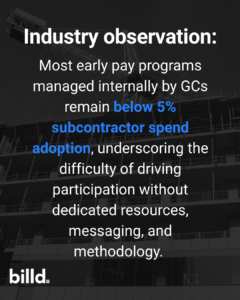
Subcontractor onboarding is often the most underestimated component of implementing an early pay program. Participation typically requires multiple interactions: introducing the program, explaining how it works, answering questions, handling objections, using different content and messaging, establishing agreements, and guiding subcontractors through their first early payment. Even if a general contractor can operate the program internally, subcontractors may be reluctant to openly discuss working capital needs with a GC, particularly if they worry it could affect how they are viewed on future projects.
For most general contractors whose core competency is building projects, operating a financial program and driving adoption often become secondary responsibilities. A helpful analogy is trade work on a project: While a GC could perform many trades internally, they typically rely on specialists because those partners bring efficiency, scale, and expertise.
If a general contractor decides to use a partner to run their early pay program, there’s a list of criteria for them to evaluate before making a decision.
1. Long-Term Partnership and Construction Expertise
Choosing an early pay partner is a commitment. These multi-year programs become deeply integrated into a general contractor’s workflows, making a partner’s financial stability and dedication to the construction industry essential. The relationship is a true partnership, not just a simple technology purchase, because the financial goals are mutually aligned.
The ideal partner should have an experienced team and provide access to leadership if concerns need to be escalated. Because they serve as an extension of your organization when engaging with subcontractors, they must have a deep understanding of construction, speak the industry’s language, and communicate in a way that builds trust with trade partners. Their interactions directly reflect on your business and are vital for driving program adoption.
2. Subcontractor Outreach and Adoption Strategy
Subcontractor participation drives the program’s success. A strong partner should have a structured outreach strategy, including a phasing plan, and a clear approach to subcontractors.
Trade partners absorb information in different ways. Some prefer short summaries; others want detailed explanations, videos, FAQs, and calculators; and many respond best to direct conversations. Effective programs, therefore, use multiple communication channels rather than a one-size-fits-all approach.
Outreach and communications should also be consultative and low-pressure. The goal is to educate subcontractors on how the program works and when it may benefit their business, rather than pushing participation. This approach builds trust and leads to stronger long-term adoption.
3. Technology and Platform Evolution
Technology plays an important role in supporting and scaling the program. Whatever platform used for the early pay program should streamline onboarding, support early pay elections, and integrate with existing payment processes.
Equally important is the partner’s ability to evolve the platform over time. As the GC’s and subcontractors’ needs change and the program expands, the technology must adapt. If standard platform improvements take months to deliver, it may signal that early pay programs are not a core focus of the provider or are not properly staffed to meet your needs.
4. Pricing Flexibility
A single pricing structure rarely works for every subcontractor as trade partners vary significantly in size, access to capital, and project economics. Programs that can offer multiple pricing options are typically better positioned to attract participation from a broader base of subcontractors while still supporting the contractor’s financial objectives.
5. Funding Strategy
The funding strategy should also be considered when selecting a partner because the optimal funding approach may evolve as the program grows. General contractors may initially prefer self-funding as they want to capture the return. As adoption increases and financial objectives change over-time, funding strategies may shift.
A strong partner should support multiple funding structures and adapt as the program matures.
6. Implementation Discipline
Successful programs are rarely launched all at once. The most effective deployments follow a phased rollout that allows the organization to crawl, walk, and then run. A strong partner should bring a clear implementation plan that includes project plans, onboarding timelines, internal training, phased subcontractor outreach, internal and external communications plans, and defined success metrics. Early pilots allow general contractors to test workflows and refine the program before expanding across additional projects and trades.
This disciplined approach reduces operational risk and improves adoption as the program scales.
Choosing the right partner is a strategic decision, not merely a technological one. This choice is critical to whether your early pay program remains a limited initiative or evolves into a scalable tool that delivers long-term financial value, improves margins, and strengthens subcontractor relationships. Therefore, the company you partner with—their viability and industry expertise—is highly important.
The real test of a partner is not when everything is going to plan, but in their ability to resolve inevitable challenges, which is a testament to their experience.