

Forward-thinking general contractors who are looking for ways to address industry-wide cash flow challenges are increasingly turning to GC early pay programs to minimize risk, save time, and keep projects on track. While early pay programs have existed for decades in retail, manufacturing, consumer goods, and other sectors, they have recently gained traction in the construction industry over the last decade.
Market drivers such as GC margins, rising material costs, labor shortages, and inflation are motivating GCs to consider solutions that help remove the all-too-familiar payment bottlenecks so common in construction. The core purpose of early pay programs is to improve the general contractor’s margins and improve returns while also helping subcontractors manage their cash flow, reducing project risks all around.
For general contractors looking to invest in these programs, there are multiple factors to consider to determine how a program would be most successful in their business, including the structure, alignment with invoice approvals, and how to encourage subcontractor adoption. Here’s an overview of what general contractors need to evaluate before implementing their own GC early pay program.
Table of Contents
What is an Early Pay Program?
Early pay programs allow GCs to pay their subcontractors earlier than the standard payment timeline of 45 to 60 days without changing the contractual value of the work the subcontractors perform. While the subcontractor pays a small fee to receive funds early, the approved work stays the same, and the project moves forward as planned.
One of the first decisions a GC needs to consider when offering an early pay program is the program’s structural model. Once these programs are established, they can run for over a decade. A GC’s cash position and needs may change during this time period, so program structure is an important first decision.
Types of Early Pay Programs
Early pay programs generally fall into two structural models based on who provides the capital for early payment: a GC-funded model or a third-party funded model.
GC-Funded Model
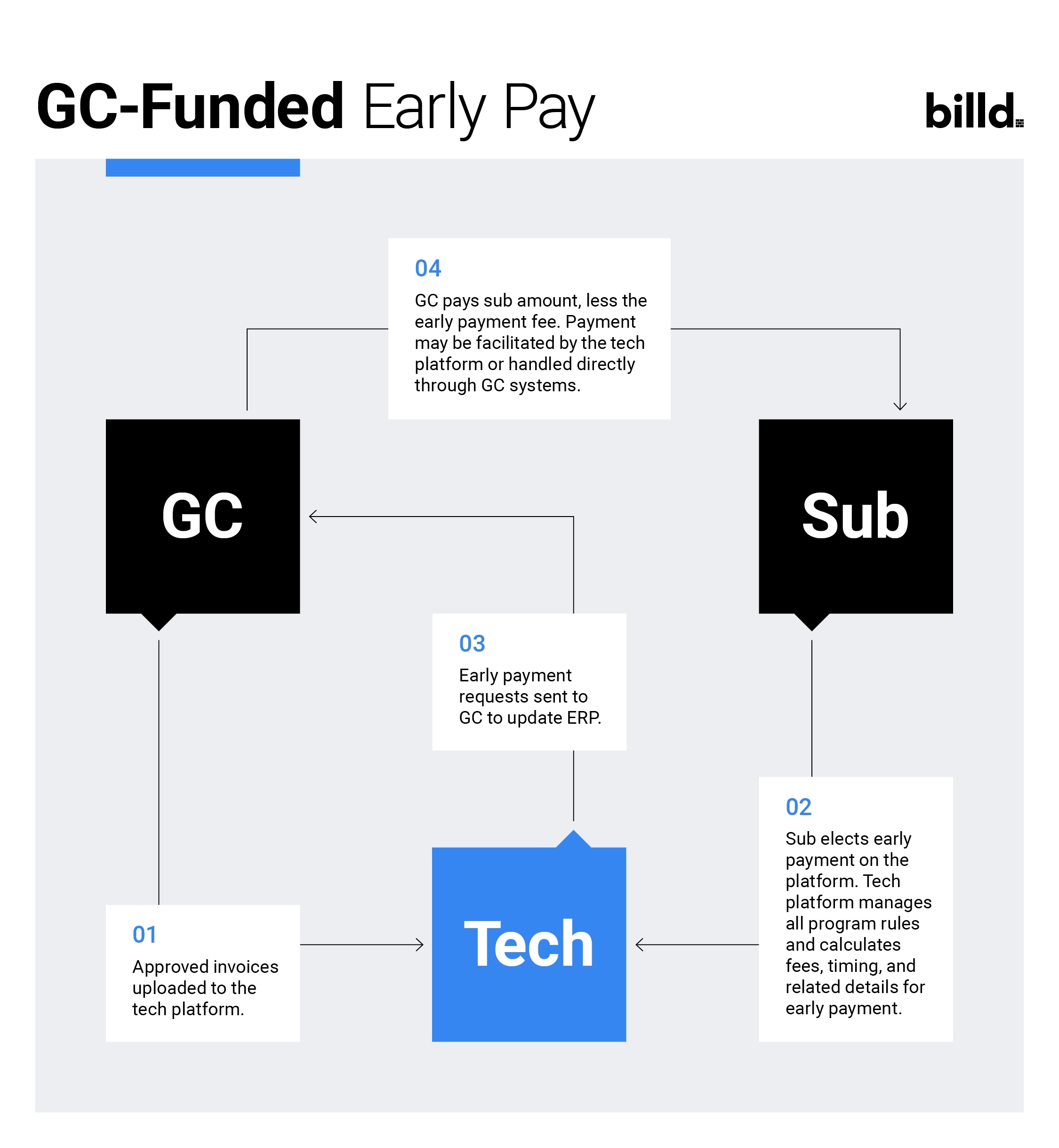
In a GC-funded program, the general contractor uses their own cash to pay subcontractors early. The GC takes on the full timing risk between paying the subcontractor and receiving payment from the project owner.
Because no outside capital is involved, the structure and contracting are relatively straightforward. The participants are the GC, the subcontractor, and a technology platform that facilitates the process. The commercial agreement between the GC and subcontractor states that any amount paid early is considered payment in full for that pay application or invoice. The discount reflects the value of early payment only, not any change to the scope, quality, or performance of work. Once paid early, the subcontractor releases all rights to collect on that invoice. A separate agreement with the technology platform governs platform access and standard terms of use without altering the underlying commercial relationship between the GC and the subcontractor.
Some of the reasons why a GC may select this structure include:
- The GC acts as the capital provider and retains the full fee on the subcontractor’s early payment.
- This structure delivers the highest possible return on the GC’s invested capital.
Third-Party Funded Model
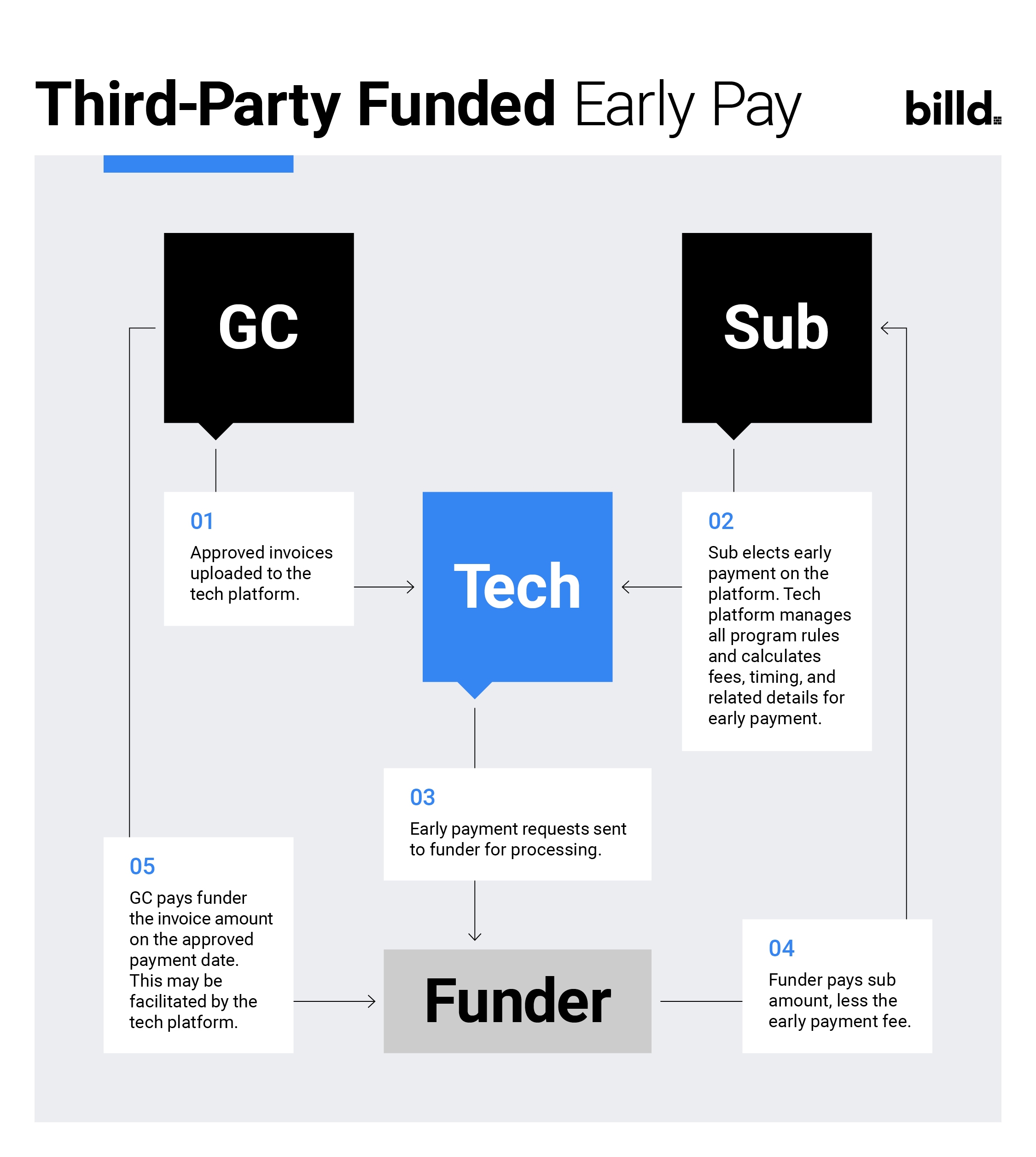
In a third-party funded program, the GC does not use their own cash to fund early payments. Instead, a separate capital provider, such as a bank, pays subcontractors early. The parties involved are the GC, the subcontractor, the technology platform, and the third-party funder.
In this market offering, the funder and platform are treated as separate. The GC enters into an agreement with the technology platform, confirming that any approved invoices uploaded to the platform will be paid in full on the approved payment date. This creates a contractual payment obligation tied to a specific date and amount. The payment risk sits with the GC, meaning performance issues or commercial disputes remain between the GC and the subcontractor.
The subcontractor signs an agreement with the third-party funder stating that if they elect early payment on an invoice, the subcontractor transfers its collection rights for that invoice to the funder. When the funder pays the subcontractor early, the subcontractor is paid in full and has no further claim on that invoice. On the approved payment date, the GC pays the funder rather than the subcontractor. The technology platform manages the invoice workflow, election process, and payment direction to ensure all parties are aligned.
Some of the reasons why a GC may select this structure include:
- A third party supplies the necessary funds for the early payment, freeing up the GC’s capital.
- The GC receives a portion of the early pay fee paid by the subcontractor, often referred to as a rebate.
- While the return is slightly lower than the GC-funded model, the GC generates revenue without deploying any of its own cash.
GC Early Pay: The Basics
- Subcontractors get paid faster in exchange for a fee for accelerated payment
- The contractual work does not change
- GCs gain improved margins and better project performance
- A funder is always involved: GC, a third party, or hybrid
How Do Early Payment Programs Work?
GC early pay programs do not significantly alter the initial workflow for subcontractors or general contractors. Subcontractors complete work and submit pay applications or invoices through the same systems and processes they use today, while the GCs maintain their standard review and approval procedures for these invoices.
The process change occurs once an invoice is fully approved. At this point, the approved invoice is sent to the early pay technology platform for the subcontractor to view. There are several ways to manage this transfer, including simple reporting, more advanced API connections, or a relatively straightforward interface available in modern invoicing or ERP systems. The technology platform provides GCs with flexible options that align with their existing back office systems and IT resources.
Once the invoice is available on the early pay platform, subcontractors see the GC-approved invoice and can then elect whether to receive early payment. Most solutions allow subcontractors to choose the timing for early payment, where they can manually select specific invoices or establish “set and forget” automations.
For example, a subcontractor might set an automation for a specific project to have every approved invoice paid 15 days early. In this scenario, as long as the invoices for that project are approved, the subcontractor will automatically receive payment 15 days earlier than the standard schedule.
How an Early Pay Program Works: A Step-by-Step Guide
- Invoice Submission and Approval: The standard process for submitting and approving invoices remains the same.
- Platform Integration: Once approved, the invoice is sent to the designated early pay platform.
- Subcontractor Election: Subcontractors have the option to choose to receive early payment for the approved invoice.
- Funding Mechanism: The source of funding determines the next step:
- In GC-Funded Programs: The early pay requests are forwarded to the GC for processing and payment to the subcontractor.
- In Third-Party Funded Programs: The early pay requests are sent to a third-party funder, who processes and provides the payment to the subcontractor.
- Invoice Settlement: The funding source determines who is responsible for the final payment:
- In GC-Funded Programs: The invoice is considered fully paid and settled after the GC has issued the early payment.
- In Third-Party Funded Programs: The invoice will have a specific due date, and the GC is then responsible for paying the third-party funder by that date, regardless if they have been paid by the owner.
GC Operational Controls
In an early pay program, it is crucial that the general contractor maintains complete control over the program’s operations. This control extends across the project lifecycle, including subcontractor eligibility, allocation, and logistics. Several key areas to watch include:
- Subcontractor Eligibility: Determining which subcontractors can participate and having the ability to remove them at any time.
- Project Eligibility: Defining which projects qualify for the early pay program.
- Invoice Eligibility: Specifying which invoices are eligible for early payment.
- Capital Allocation: Managing the total capital dedicated to the program, including funds from both the GC and any third-party providers, which allows the GC to limit their exposure.
- Invoice Due Dates: Setting the due date for every invoice uploaded to the platform.
- Program Rates and Logistics: Establishing the early pay rates available to subcontractors, the specific days on which they can submit early payment requests, and the associated processing times.
Although early pay programs are often desirable and can grow significantly, the GC ultimately has the authority to expand or limit their size and scope as needed.
Top Considerations Before Implementing an Early Pay Program
While early pay programs offer significant benefits for GCs, there are several factors to consider when implementing a new program. A successful early pay program depends on more than just workflow and payment execution—it depends on clear rules, structures, and planning to ensure payment predictability. In addition to determining the program funding structure, the following are other factors general contractors need to consider before implementing an early pay program.
Consideration 1: Providing a Predictable Timeline for Invoice Processing
General contractors can increase subcontractor participation and ensure the success of an early pay program by providing predictable and transparent timelines. A structured processing calendar is the ideal way to achieve this as it aligns expectations and provides subcontractors with the information they need to plan.
A structured processing calendar contains these key dates:
- Submission: Invoices should be submitted by a specific date (e.g., the 20th of the month).
- Issue Resolution: All issues related to the invoice must be resolved shortly after (e.g., by the 25th).
- Pencil Review: The GC’s internal review should follow (e.g., by the 30th).
- Approval and Upload: Approved invoices should be uploaded shortly thereafter, making them eligible for early payment (e.g., by the 5th of the following month).
While the exact dates may vary by GC or project, establishing consistent, defined timelines allows subcontractors to know when their invoices will be available for early payment, increasing program adoption and minimizing surprises.
Note: Even with a structured processing calendar, delays may happen, and invoices can be uploaded as soon as they are approved. Some reasons invoices may not align with the processing calendar include discrepancies in work completed, documentation, or pricing. Once an invoice receives final approval, it will then be submitted to the platform.
Consideration 2: Establishing an Invoice Due Date
The due date or approved payment date (in other industries referred to as the maturity date) represents the date the GC will pay the subcontractor in a self-funded program or repay the funder in a third-party funded program, which is why it is so important. The invoice due date is also the date that is used to calculate the fee the subcontractor pays in exchange for early payment.
GCs should be confident that the owner will fund the invoice before this repayment obligation is due. To mitigate the risk of owner payment delays, most GCs incorporate a buffer period when setting the maturity date. For example, if payment is anticipated in 45 days, a 60-day maturity date might be chosen to absorb potential delays. Typically, GCs know when they will receive payments based on their owners’ payment patterns and adjust invoices on those projects accordingly.
The selection of the invoice due date is especially critical in third-party-funded programs because the GC is obligated to pay the funder on the maturity date if the subcontractor was paid early, regardless of whether the owner has paid the GC yet.
When establishing an invoice due date, be sure to:
- Choose a date that fits with the owner’s payment timelines
- Consider placing a buffer to mitigate delays
- Carefully choose maturity dates that align to each situation
- Add extra buffer days if you have not worked with an owner before, or do not offer an early pay program for this project until you understand the owner’s payment pattern.
Consideration 3: Defining an Approved Invoice
Early pay programs depend on GC approval of invoices to advance funds. To ensure consistency, the GC must determine what “approved” means within its existing workflow and to the organization. The GC must be fully comfortable that there are no open items that would prevent the invoice from being paid early.
Some ways to define an approved invoice include:
- All required supporting documentation has been submitted, reviewed, and accepted
- Compliance items such as lien waivers, certified payroll, and insurance documents are complete
- Any disputes have been resolved with none outstanding
- A pencil review with the owner has occurred when applicable, so any issues can be corrected before early payment is offered
Invoice approval requirements can vary per general contractor, so following best practices and aligning on approval criteria will ensure a smooth transition to an early pay program.
Consideration 4: Ensuring Payments Are Made Electronically
Timely payments are essential for an effective GC early pay program. Electronic payments such as ACH transfers ensure predictable timing and reduce administrative delays, which is why they are the preferred form of payment for early pay.
If a GC pays subcontractors by check:
- Mailing and deposit delays limit early pay effectiveness
- Checks must be transitioned to ACH
- The early pay provider must assist with ACH conversion
Checks undermine the purpose of early pay by introducing mailing time, deposit delays, and unpredictability. They also reduce the subcontractor’s net benefit and can discourage participation. These factors undermine the effectiveness of early pay programs, which is why payments should be made electronically.
Consideration 5: Subcontractor Outreach and Onboarding
The ultimate measure of success for any early pay program, regardless of the industry or technological sophistication, is adoption. Without widespread use by subcontractors, the intended value for both the GC and the subcontractor will not be realized. Since subcontractors are essential partners, the onboarding experience—a direct reflection of the GC—must be handled with extreme care.
Key Considerations Before Subcontractor Outreach:
Before initiating contact with your subcontractors, ensure the following elements are finalized:
- Staffing and Capacity: Who is responsible for outreach to subcontractors, and do they have the time and personnel to do so?
- Messaging and Objection Handling: What is the core message of the program, and how will common subcontractor objections be addressed?
- Target Prioritization: Which subcontractors will be prioritized for outreach, and what is the strategic rationale behind this selection?
- Pricing Structure: What are the program’s pricing considerations, and how will it be priced?
- Cash Flow Dialogue: Will subcontractors be willing to openly discuss their specific cash flow requirements with you?
- Onboarding Experience: What is the detailed onboarding process, and what will the overall user experience be like?
- Support Content: Do you have comprehensive content ready to answer questions and address potential concerns?
Gaining subcontractor adoption requires time, resources, and specific knowledge, which is why GCs often find it most effective to partner with a technology platform that specializes in managing the outreach and onboarding services. Otherwise, the burden of these crucial activities falls entirely on the GC.
Early Pay Programs: Are They Worth The Effort?
Early pay programs are undeniably beneficial. They offer general contractors improved margins and allow GCs to work with financially stable subcontractors, which reduces the risk of project delays and can make the GC the contractor of choice for subcontractors.
In comparison to other system rollouts, early pay programs are relatively straightforward and quick to deploy, typically in under 60 days. They don’t require replacing existing technology; instead, they enhance or augment your current platforms. These solutions are well-established in other sectors, with an estimated 70% of the Global 2000, including Cemex, Boeing, Siemens, Ford, Nissan, Walmart, Caterpillar, Whirlpool, and Lowe’s, having deployed early pay programs within their supply chains. The construction industry is catching up.
Given this widespread adoption and proven benefits, the answer is clear: early pay programs are worth the effort. The reality is they will become standard practice in the coming years, making the decision for adoption a matter of when, not if.
Are you ready to take the next step? As the pioneer in transforming construction finance, Billd offers GCs an early pay program that does all that and more. Learn about it here .