

For general contractors, launching an early pay program is a strategic investment in your supply chain. The goals of your program are straightforward: generate margin, help subcontractors improve their cash flow to de-risk projects, and differentiate your company as a GC that actively supports its trade partners. Whether your early pay program is managed manually through email communications or supported by a technology platform, your organization is able to run and fund the program internally.
If you have an existing early pay program, you are in good company. Our estimates suggest that approximately 15 to 20% of general contractors in the United States have implemented some form of an early pay program.
Yet after launching the program, subcontractor adoption is often lower than expected. Oftentimes only a small percentage of subcontractors participate in early pay programs, and only a portion of project spend flows through the program.
Low adoption can be confusing because subcontractor demand for faster payment is well-documented. Payment delays remain a persistent challenge in construction, putting pressure on subcontractor cash flow. Additionally, more than three-quarters of subcontractors say they would be willing to offer a discount in exchange for faster payment*.
If subcontractors are willing to accept discount fees for faster payment, early pay programs should see meaningful participation. So why isn’t this always the case?
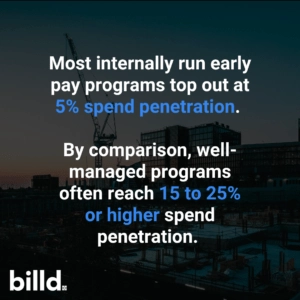 Despite this demand, many internally managed early pay programs struggle to move beyond single-digit adoption, which is measured by subcontractor spend paid early.
Where does your program stand?
Across the construction industry, the issue with poor adoption is rarely the early pay concept itself. More often, the challenge lies in how internally managed programs are structured, communicated, and operated. Here are some common examples of challenges GC-managed early pay programs face.
Table of Contents
Subcontractor Adoption Does Not Happen Automatically
Launching an early pay program does not automatically lead to subcontractor participation. While the mechanics of early payment may be straightforward, adoption requires active engagement with subcontractors. Many internally managed programs struggle to gain traction because the outreach and education required to drive participation are often underestimated.
Deciding Who Owns Subcontractor Engagement
Driving adoption requires individuals to speak with subcontractors, explain the program, and answer questions about how it works and its benefits.
Within most GC organizations, ownership of this responsibility can be challenging. Project teams focus on delivering against project scope and timeline, procurement teams manage contracts, and finance teams manage payment operations. Few organizations are able to dedicate resources who can be responsible for educating subcontractors about early pay programs. Oftentimes, this means the responsibilities are left to one or two people as a part-time project, which is rarely enough to drive results.
When it comes to managing subcontractor engagement, ask yourself: Who is best positioned to have this role? Do they have the right messaging? And most importantly, are they compensated for the program’s success?
Finding the Right Point of Contact
Another challenge that often arises is reaching the right person inside the subcontractor’s organization. In many cases, the GC’s primary point of contact for the subcontractor is a project manager or operations lead. These individuals manage the project but are rarely responsible for financial decisions. Those decisions typically sit with the owner, CFO, controller, or finance team.
As a result, communication about the program is often with the daily point of contact, who then has to carry the message internally. Information can get lost, questions go unanswered, and the program benefits may never reach the person responsible for managing cash flow.
The practical question then becomes: Can you identify and communicate directly with the financial decision-makers within your subcontractor base, or are you relying on project contacts to relay the message internally?
Helping Subcontractors Feel Comfortable Talking About Their Finances
Subcontractors are often hesitant to discuss working capital needs with their customers, even when early pay programs would benefit their cash flow. This reluctance stems from a concern that disclosing their capital position could negatively impact how their bids are viewed for future projects. Consequently, subcontractors may avoid discussing financing options entirely, even when a viable program is available.
In a recent market report, Billd discovered that 83% of subcontractors worry about cash flow** yet when a GC speaks to their subcontractors, they may not want to talk openly about their concerns. Without a third party, there may not be as much transparency around working capital needs.
Adoption Requires Persistent Effort
Subcontractor adoption rarely occurs after a single announcement, a few emails, or a page on the website. Successful programs require ongoing outreach, repeated communication, and consistent engagement with subcontractors across projects. Without sustained effort, even well-designed early pay programs often see limited participation.
Examples of subcontractor touchpoints include introducing the program during bidding, subcontractor onboarding, discussing it during project kickoff meetings, approving invoices, and making payments. Without ongoing communication, many subcontractors simply forget the program exists or fail to recognize when it may be useful.
Working Capital Solutions Are Not a Core Competency
Construction companies are experts at managing projects and coordinating trades. Developing messaging and content around financial solutions, however, is rarely a core competency within GC organizations. By contrast, explaining working capital tools and their pros and cons to subcontractors requires financial education, examples, and ongoing dialogue.
A GC recently shared details of their self-managed early pay program. This program is fully managed and funded by the GC. While they use their current invoicing platform to facilitate early pay transactions, the technology provider does not offer any servicing for the early pay program. The GC indicated that adoption is low and a priority is increasing adoption, with plans to create new messaging and content to boost subcontractor participation.
This raises two key questions: Is creating this content the best use of the GC’s resources, and do they possess the necessary expertise to execute this effectively?
Effective Objection Handling Is Critical
As subcontractors learn about early pay programs, questions and objections naturally arise. One of the most common responses from subcontractors is:
“Why would I pay to get paid money that I am already owed?”
This reaction is understandable. From the subcontractor’s perspective, the invoice represents work that has already been completed and approved. Without additional context, paying a fee to accelerate payment can feel counterintuitive.
Addressing these objections requires thoughtful, consistent responses that help subcontractors understand how early payment works, its benefits, how to compare alternatives, and the rationale for offering it. For these conversations to be effective, the messaging and content must be thorough and consistent. Subcontractors should receive similar explanations regardless of who they speak with within the organization.
Without a defined approach to objection handling, subcontractors may receive inconsistent answers or incomplete explanations, which can create confusion and reduce trust in the program. Over time, this uncertainty can become another barrier to adoption.
Pricing Strategies: Not One-Size-Fits-All
Pricing is another area where internally managed programs often struggle. Should it be fixed or time-based? What price should a GC charge? Many programs are structured for simplicity by offering a fixed discount rate, typically 2%, which means a fixed 2% comes off the invoice value when paid early. Structured pricing makes it easy to explain the program to the subcontractors and makes it easier for the GC to process requests. A one-size-fits-all approach.
If using a time-based structure, the payment’s timing significantly impacts the effective APR for a subcontractor charged a fixed rate. At a 2% fixed rate, receiving funds 45 days earlier results in an equivalent APR of 16%. This rate increases to 24% if paid 30 days early, and jumps to 48% with a 15-day early payment. Therefore, faster processing times dramatically reduce the effective rate of the fixed 2% charge. Same cost, however, very different rates compared to alternative financing solutions.
Most successful programs offer pricing tiers and pricing options (fixed and time-based) for different types of subcontractors to drive adoption and value for their trade partners.
Pricing may vary based on factors such as:
- High spend vs. low spend trade partners
- Specialized trades vs. commoditized services
- Strategic projects vs. standard projects
- DBE subcontractors
Who owns the pricing strategy?
Few general contractors have internal resources to manage the commercial elements of an early pay program, including pricing strategy and handling subcontractor pricing objections. If there is only one pricing option offered, adoption will quickly reflect subcontractors’ views on the pricing being offered.
If a GC decides to own their own program and pricing needs to be actively managed, there are several important questions related to program management and subcontractor engagement for a GC to consider:
- Pricing Strategies & Objections: Who within the GC organization is responsible for managing pricing and addressing subcontractor objections? How will pricing concerns be handled, and who has the authority to approve adjustments or lower-priced requests when appropriate? Are pricing changes permanent or temporary?
- Alternative Financing Solutions: How should the GC respond when a subcontractor discusses the prices of alternative financing options that they may already be using or considering? Do GCs know the pros and cons of the other funding options to differentiate the offerings? The price is often not the only consideration when picking working capital solutions.
What Can You Do If Your Program Is Struggling?
If you have launched an early pay program and adoption has been lower than expected, you are not alone. Many general contractors managing their own programs are facing similar challenges.
The good news is that these challenges are often solvable.
Broadly speaking, general contractors have two paths forward.
1. Fix The Internal Program
Some general contractors choose to continue managing their program internally and focus on addressing the issues outlined earlier. Fixing the program may include:
- Assigning more internal resources to actively manage adoption and compensating them accordingly
- Increasing subcontractor outreach and educational content
- Improving how the program is communicated and to whom
- Refining pricing strategies and addressing subcontractor objections
With the right focus and sustained effort, internally managed programs can improve participation over time. However, doing so requires time and resources that many GC organizations may find difficult to maintain alongside their core operational priorities.
2. Partner With an Early Pay Provider
Another option is to partner with organizations that specialize in running early pay programs. These providers focus specifically on program management, subcontractor outreach and onboarding, education, pricing discussions, objection handling, and adoption strategies. In many cases, their commercial models are success-based, meaning they only earn revenue when the program is used. Their incentives are aligned with the GC; they succeed only when the program succeeds.
While partnering may mean sharing a portion of the program economics, the difference is often not material when compared to the increase in adoption and overall program utilization. GCs will also save an immense amount of time by not having to manage all the functions they currently handle to support the early pay program.
An alternative solution that saves time and increases revenue is worth considering.
Do I need to deploy the provider’s early pay platform?
GCs sometimes express reluctance to work with an early pay provider because they worry the provider will mandate using a new, separate platform to manage the early pay program. The GC may prefer to continue using their existing integrated invoice platform, which supports some early pay capabilities.
Fortunately, some early pay providers can fully manage the program for the GC without forcing a transition to a new technology platform. The goal is adoption. If that can be achieved using the GC’s current technology, that approach is workable. While specialized platforms exist and can be used when existing solutions lack certain capabilities and hinder adoption, they are not mandatory in many instances. A provider can present the pros and cons of the different alternatives, and together you can make the right decision that works for you and the program.
A Model the Construction Industry Already Understands
Construction companies regularly partner with specialized trades even when they technically have the capability to perform the work themselves. Electrical, plumbing, concrete, and excavating, among other trades, require expertise, focus, and dedicated resources. Even when a GC could perform portions of that work internally, it often makes more sense to rely on specialists who focus on those disciplines every day.
Early pay programs can follow a similar model.
Final Perspective
While early pay programs offer significant value to both general contractors and subcontractors, their success ultimately depends on having the expertise and the resources to execute. If your program is experiencing low adoption or you are questioning its value, first consider whether the challenges you face align with the common obstacles outlined above. Before abandoning your efforts, evaluate your current approach, implement the necessary changes, and consider whether experienced partners may help unlock the program’s full potential.
*Source: PYMNTS Intelligence, The Construction Problem Few Talk About: Payment Delays, 2026
**Source: Billd, 2026 National Subcontractor Market Report, 2026