Billd Named No. 2 on Forbes' List of America's Best Startup Employers

2025 National Subcontractor Market Report

Subcontractors with a strong capital strategy are getting ahead and staying there year over year

01 About the Report

01

About the Report

Billd surveyed subcontractors nationwide in 2024, analyzing their responses to build the 2025 National Subcontractor Market Report.

Each year, the survey digs into the financial and economic conditions of commercial construction subcontractors.
Over 800 construction professionals, 88% of which have been in business for 10+ years, lent their perspectives to create this year’s report.

02

Operating Environment

How Long-Standing Industry Problems Continue to Affect Subcontractors

The stats from this year’s report reveal a familiar picture: Slow pay and cash flow strain are keeping profits stuck in subcontracting businesses.


The good news

Now more than ever, subcontractors are combating the effects of these industry norms with a more strategic approach to working capital—and it’s paying off.
It’s notoriously difficult for even the most meticulous subcontractors to maintain control over their profit margins. Partially to blame is the fluctuating total cost of working capital that is necessary to fund any project. Regardless of which sources are leveraged, working capital carries a real cost in the form of daily interest and finance charges, which accumulate as DSO (days sale outstanding) rises. The issue compounds with unexpected project changes that create payment delays, which is unfortunately common. The result: subcontractor owners are forced to absorb the cost of working capital.
However, as revealed in last year’s report, there are a subset of subcontractors who don’t feel this pain as deeply as their peers. Instead, they understand the cost of working capital, and shield their profits against it by including the cost in their bids.
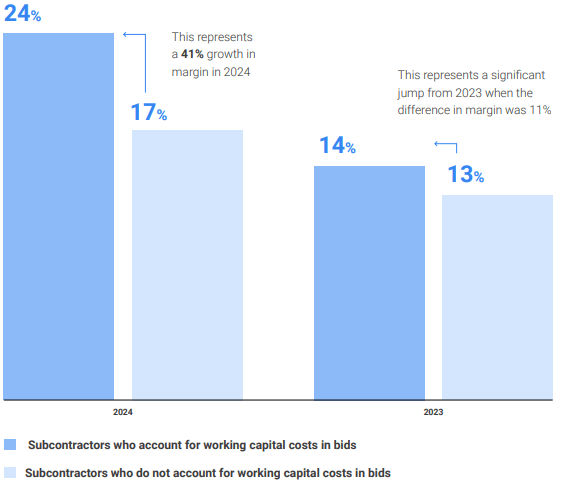
Subcontractors who account for the cost of working capital in their bids saw a
0 %
increase in profitability
compared to those who do not. This is a significant upswing for this group, who reported an 11% difference in the year prior.
They are more likely to report revenue growth, profit growth, larger profits, and higher win rates on bids.
There’s a reason 52% of subcontractors believe their GCs don’t understand the importance of prompt payment. The pain of slow payment cycles is not readily apparent to many GCs. As a result, GCs casually throw out payment timelines to the tune of “30” or “60” days, as if those aren’t starkly different timelines with starkly different consequences for the subcontractor’s cash flow. Long payment cycles have an effect on a subcontractor’s ability to effectively do their job and this truth seems lost in many ways among the GC community. Everyone in the industry acknowledges that cash is king, but GCs aren’t always putting subcontractors in a position to operate with the cash they need. It’s easy to blame the owners for their timelines, but it’s the GCs’ responsibility to emphasize the sense of urgency upstream.
Last year, we saw a modest difference in profit between subs who did this and those who didn’t. This year, the difference in profit between these two cohorts is staggering.
Not only is there a transformative increase in profitability, but these subs also see more substantial gains in the realm of revenue growth and ability to secure projects.
The fact that strategically priced bids yield higher profits is not surprising, but some may assume that bid win rates decrease as subcontractors incorporate more costs. Interestingly, this is the exact opposite of what we see:
Subcontractors who diligently use and account for the cost of working capital in their bids are winning more projects than their peers.

Subcontractors account for the cost of working capital in their bids as part of a construction-savvy capital strategy. Those businesses might see higher win rates because:

They use outside working capital to predictably pay material invoices, earning more competitive unit pricing that is directly reflected in their bids
They reinvest in their business more readily, creating cost- and time-saving efficiencies that strengthen their competitive edge
They proactively position themselves to take on larger, more complex projects typically reserved for a smaller pool of qualified subcontractors
When growth-ready subcontractors eliminate the burden of poor cash flow they can confidently demonstrate their ability to execute, which ultimately wins over general contractors.
The benefits are clear: proactively creating a capital strategy that leverages multiple sources and maximizes capacity empowers subcontractors to put their business interests first with no discernible consequences to profit margins or win rates.

03

The Long-Standing Legacy Of Slow Pay In Construction

Unpredictable Payment Cycles Remain a Challenge

0 %
of subcontractors said they are generally slow paid by GCs
0 %
of subcontractors report coming out of pocket for materials before receiving payment
0 %
of subcontractors report coming out of pocket for labor
The combination of slow, unpredictable pay with the expectation of large upfront costs forces subcontractors to assume the entire financial responsibility for the $1.5T construction industry. Additionally, it can leave subcontractors feeling uncertain about the financial resiliency of their businesses.
Unfortunately, the statistics suggest that subcontractors do not overcome these challenges simply through growth. From day one, relying only on accounts receivable to come in without interim working capital is not a viable option.
0 %
of subcontractors have supplier terms less than their average DSO
0 %
of owners running $15M+ businesses use their personal savings to cover cash flow deficits
Traditionally, subcontractors have resorted to inefficient practices to cover cash flow deficits, including using supplier terms that don’t align with their DSO and tapping personal savings. These inefficiencies have long been accepted as an inevitable facet of the industry. However, it doesn’t have to be this way. A proactive working capital strategy won’t break the cycle—but it gives subcontractors the upper hand by working with the realities of the industry while protecting cash.
0 %
of subcontractor business owners reported worrying about their business’s cash flow
0 %
believe they have the working capital available to cover unexpected costs*
*This number is lower for subs under $15M in revenue, indicating a greater burden on this group

04

A New Way to Combat the Effects of Slow Pay: A Strong Capital Strategy

In 2024, Billd authored a guide on how to build a capital strategy that allows subcontractors to operate efficiently despite cash flow unpredictability. It starts with obtaining a variety of working capital options, including cash, supplier terms, bank lines of credit, credit cards, and construction-specific financing options. This last one is important because traditional financing options are not catered to construction, making them less than ideal because they have limits that don’t meet the needs of construction businesses. By maximizing credit availability across a diverse set of capital options, subcontractors can create a safety net that becomes the foundation for growth.

The combined impact of these options depends on how and when they are deployed. The rule is simple: Use the least flexible capital options first, and the most flexible options last. For example, supplier terms are rigid in that they can only be used for one type of expense, there are time constraints on when they can be used, and they can only be used for so long. Therefore, using those first instead of a more flexible option ensures you’re not fo

Cash is King, Treat it Like a Queen

Cash is a subcontractor’s most valuable asset because it enables them to invest back in any area of the business they see fit. Unfortunately, this ultraflexible form of capital is often what subcontractors reach for first. When cash flow is stunted, the cash on hand is pulled directly from the profit. All too often, that means retained profit over several years becomes the business’ default working capital.
0 %
of subcontractors reported that over half to ALL of their annual profit is kept in the business as working capital
The objective of a deliberate capital strategy is to free profits from being the plug in the never-ending cash flow gap. Whether the goal is to pull profit from the business now versus at the time of sale, or to reinvest in areas of the business that support growth, cash needs to be protected.

05

Proactive Subcontractors Are Driving Change

There’s another reason cash as capital is appealing: The “cost” of cash is free compared to other working capital options. Once cash is exhausted, some subcontractors reach for the next most cost-effective form of capital, like a bank line of credit. It can seem like a better alternative to use your cash to save on the cost of capital, but nothing is free.
Instead, savvy subcontractors resist the urge to deploy working capital in order of least to most costly. They realize that it takes a variety of working capital options to run their businesses effectively and that using capital doesn’t mean they have to eat the cost of it. A growing number of subcontractors are not only leveraging multiple options, but they're also accounting for the costs of capital in their bids. And the differences between those who do and those who don’t is staggering, especially when you look at their profit margins.

Average Profit Margins Of Subcontractors

0 %
Account for cost of capital in their bids
0 %
Do not account for the cost of capital in their bids
The survey revealed that subcontractors who account for the cost of capital have a growing advantage that cannot be ignored.
0 %
This amounts to a 41% increase in profit, among many other benefits to be highlighted later on.

06

Defining the Status Quo in Construction

The Slow And Unpredictable Payment Cycle Isn’t Going Away

The survey results reveal the severity of the issue and how widespread it is. The stats also underscore that it’s an issue not well understood by general contractors.

0 days
How long GCs think it takes subcontractors to get paid
0 days
How long it actually takes subcontractors to get paid

That 26-day perception-versus-reality gap is not insignificant to the subcontractor businesses waiting for payment.

Subcontractors Cannot Rely on General Contractors to Find Solutions

0 %
of subcontractors said they are generally slow paid by GCs
0 %
of subcontractors believe GCs don’t understand the importance of prompt payment
0 %
of subcontractors believe GCs don’t express the urgency of prompt payments to the owner

Subcontractors wait on average 56 days to get paid after they submit a pay application, consistent with the average of 57 days in the 2024 National Subcontractor Market Report. Even as technology advances to streamline the payment process and general contractors have become more aware of the impact slow pay has on subcontractors, the problem is still rampant. The end result is growing pressure caused by the funding gap.

What Is the Funding Gap?

The funding gap represents the financial deficit between the amount of expenses subcontractors need to fund, and how much capital they actually have at their disposal between available working capital and cash from their projects. Funding gaps are a pervasive issue that affect subcontractors of any size, from $5M in revenue to $100M in revenue, because the issue is rooted in the faulty mechanics of the industry. For subcontractors, vital cash is often tied up in late payments from GCs and traditional working capital solutions are limited in what they can offer. The statistics below illustrate the shortfalls in funding that subcontractors deal with.
The Funding Gap, by the Numbers

0 %
of subcontractors report not having enough working capital to cover unexpected expenses or project delays
0 %
of subcontractors making $15M+ in revenue seek more working capital before they need it, so the remaining majority are not prepared when they suddenly need more

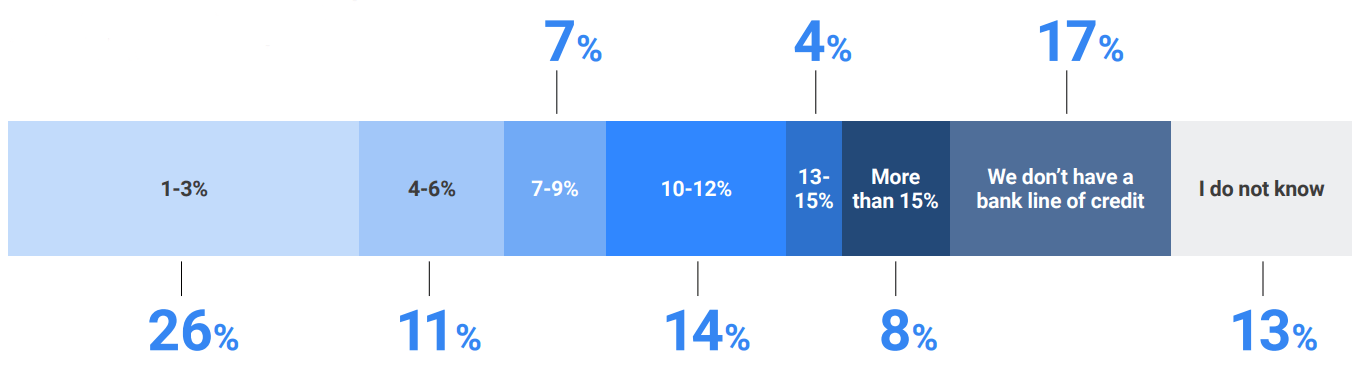
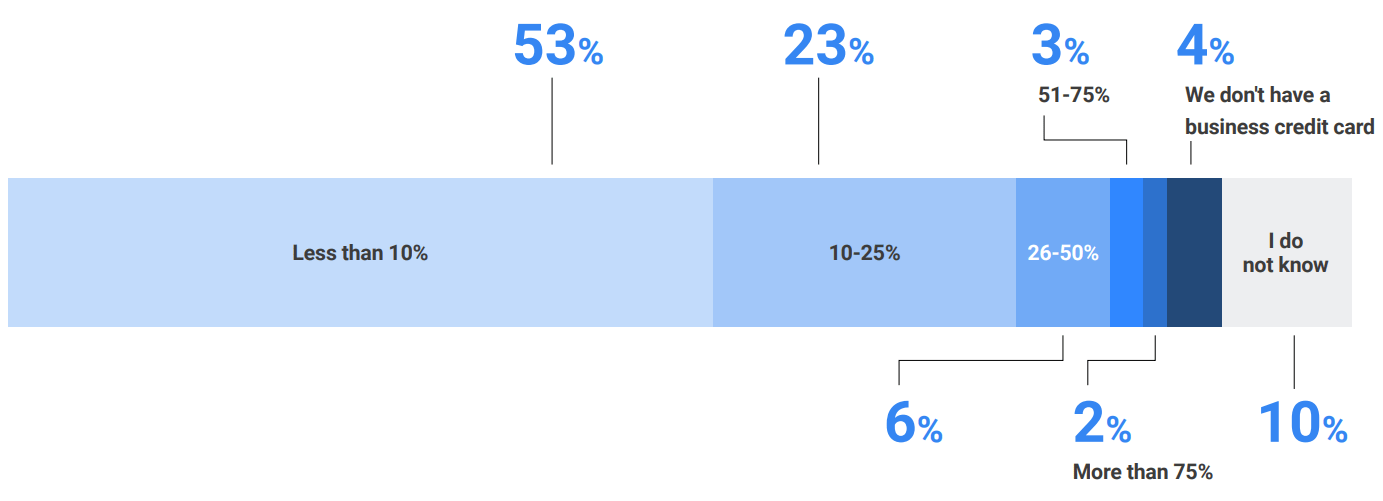
Traditional Working Capital Solutions Are Not Enough To Meet The Need

What percentage of your annual revenue is covered by your bank line of credit?

What percentage of your monthly revenue is covered by your business credit cards?

The graphs above illustrate why subcontractors need more than bank lines of credit and credit cards to cover their expenses

How the Funding Gap Impacts Subcontractors

Overdue Accounts Payable

Sometimes slow pay can lead subcontractors to slow pay their own invoices, which can negatively impact relationships with vendors and force suppliers to increase prices for subcontractors
0 %
of subcontractors said overdue invoices get in the way of progress or success on their projects
0 %
of subcontractors reported sometimes having to pick and choose which invoices they pay on time

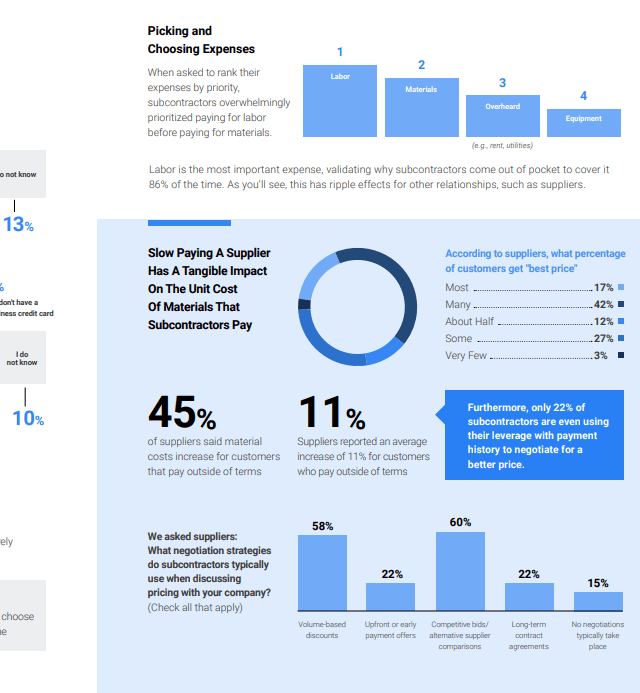
Picking and Choosing Expenses

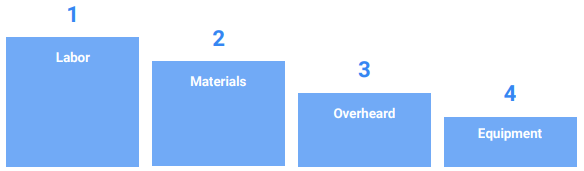
When asked to rank their expenses by priority, subcontractors overwhelmingly prioritized paying for labor before paying for materials
Labor is the most important expense, validating why subcontractors come out of pocket to cover it 86% of the time. As you’ll see, this has ripple effects for other relationships, such as suppliers

Slow Paying A Supplier Has A Tangible Impact On The Unit Cost Of Materials That Subcontractors Pay

According to suppliers, what percentage of customers get "best price"

17%
Most
42%
Many
12%
About Half
27%
Some
3%
Very Few
0 %
of suppliers said material costs increase for customers that pay outside of terms
0 %
Suppliers reported an average increase of 11% for customers who pay outside of terms

Furthermore, only 22% of subcontractors are even using their leverage with payment history to negotiate for a better price.

We asked suppliers: What negotiation strategies do subcontractors typically use when discussing pricing with your company?

0 %
Volume-based discounts
0 %
Upfront or early payment offers
0 %
Competitive bids/ alternative supplier comparisons
0 %
Long-term contract agreements
0 %
No negotiations typically take place

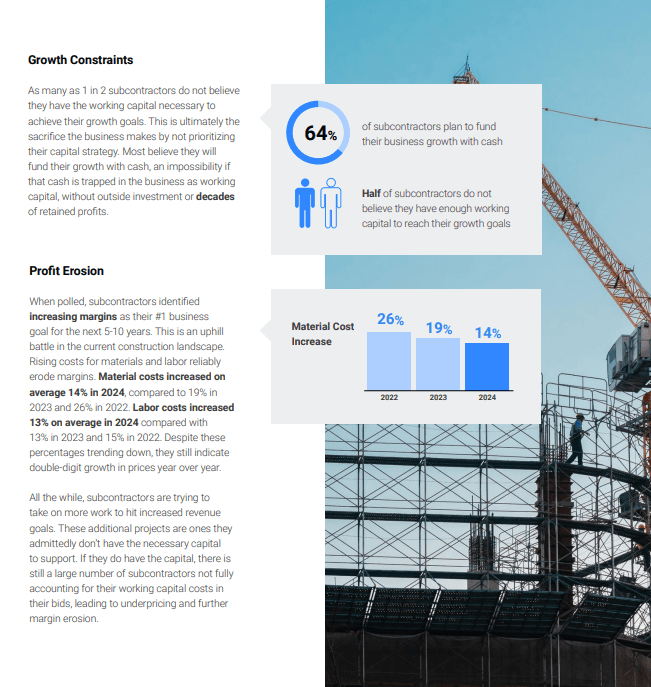
Growth Constraints

0 %
of subcontractors plan to fund their business growth with cash
Half of subcontractors do not believe they have enough working capital to reach their growth goals
As many as 1 in 2 subcontractors do not believe they have the working capital necessary to achieve their growth goals. This is ultimately the sacrifice the business makes by not prioritizing their capital strategy. Most believe they will fund their growth with cash, an impossibility if that cash is trapped in the business as working capital, without outside investment or decades of retained profits.

Profit Erosion

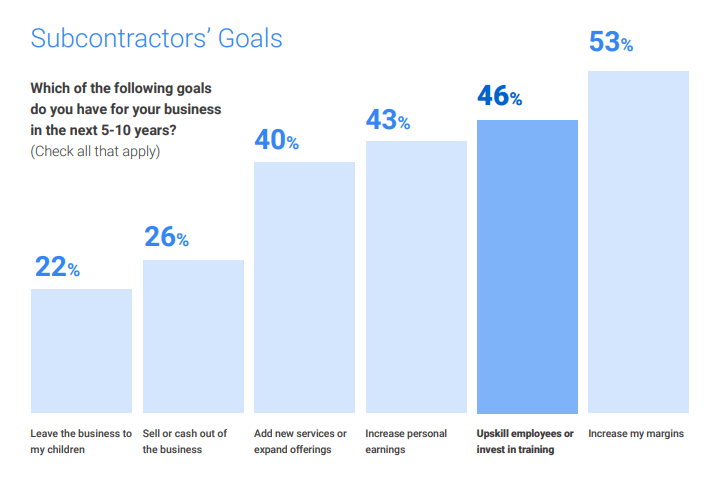
When polled, subcontractors identified increasing margins as their #1 business goal for the next 5-10 years. This is an uphill battle in the current construction landscape. Rising costs for materials and labor reliably erode margins. Material costs increased on average 14% in 2024, compared to 19% in 2023 and 26% in 2022. Labor costs increased 13% on average in 2024 compared with 13% in 2023 and 15% in 2022. Despite these percentages trending down, they still indicate double-digit growth in prices year over year.

All the while, subcontractors are trying to take on more work to hit increased revenue goals. These additional projects are ones they admittedly don’t have the necessary capital to support. If they do have the capital, there is still a large number of subcontractors not fully accounting for their working capital costs in their bids, leading to underpricing and further margin erosion.

Material Cost Increase

0 %
2022
0 %
2023
0 %
2024

Financial Awareness in the Industry

Many business owners struggle with accurately tracking their cash position, often overestimating available funds by mentally allocating the same dollar to multiple expenses. This creates a false sense of financial security and can exacerbate issues with working capital management.
0 %
of business owners with $15M+ in revenue do not know how much of their revenue is covered by their bank line of credit, indicating potential gaps in financial awareness or management
0 %
of business owners with $15M+ in revenue do not know their typical bank line of credit usage, indicating that many businesses lack visibility into their financial metrics
To avoid unexpected cash shortages and make better-informed decisions, subcontractors should implement more rigorous financial tracking systems. This will provide a clearer picture of financial health and enable better resource allocation.

How the Funding Gap Affects GC and Labor Relationships

Despite GCs contributing to slow pay, they still hold the expectation that subcontractors should have robust financial resources to cover multiple project costs. When subs mismanage their capital, it ultimately hurts their performance in the eyes of the GCs.

0 %
of GCs said it is important that subcontractors on their projects have strong working capital
0 %
of subcontractors making $15M+ in revenue reported working with more than 10 GCs in 2024, requiring a strong working capital position on each job regardless of DSO by GC

How Subcontractors Get Best Unit Cost

Subcontractors may believe they are getting the best unit prices by shopping suppliers against one another. But in reality, suppliers are factoring in the costs of not being paid on time, so the “best price” one subcontractor sees might be more than another who pays on time. In other words, a subcontractor who pays within their net 30 terms gets a better price on materials than one who waits to pay until day 60, making the first sub’s bid more competitive than the one who takes longer to pay.

What negotiation strategies do you typically use when discussing pricing with your suppliers?

0 %
Competitive bids/alternative supplier comparisons
0 %
Volume-based discounts
0 %
Upfront or early payment offers
0 %
Long-term contract agreements
0 %
No negotiations typically take place

07

How Supplier Terms Don’t Effectively Address the Funding Gap

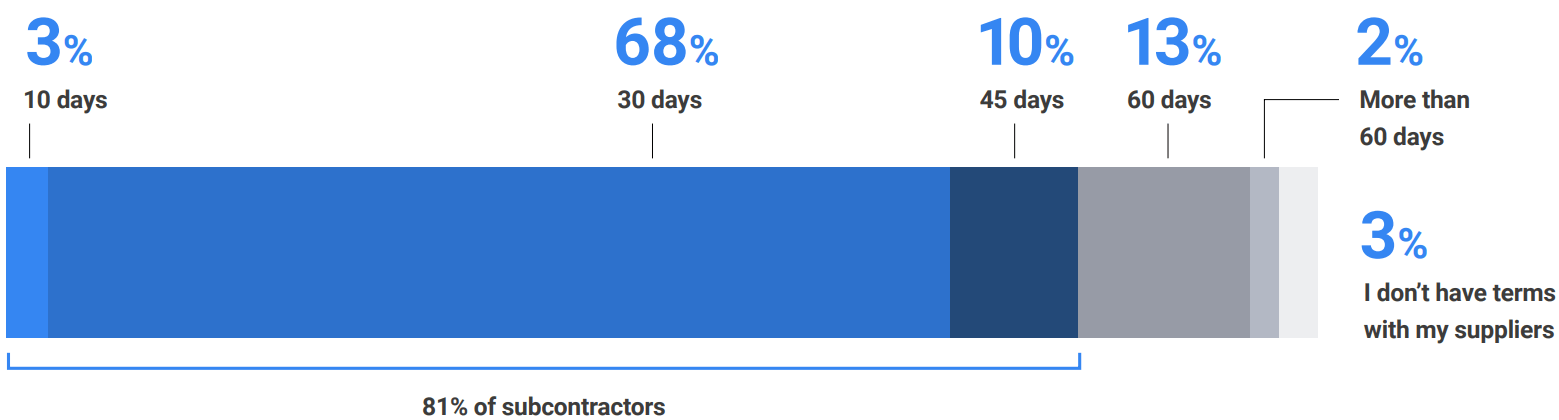
Supplier terms remain the preferred method for subcontractors to purchase materials, with almost 100% reporting that they have terms with suppliers, and over 76% using them more frequently than any other purchasing option. However, these terms are and have always been insufficient: The most common terms, net 30, are too short to bridge the gap between purchasing materials and collecting payment.
This gap forces subcontractors to rely heavily on alternative working capital once supplier terms have been maxed out, which further underscores why it’s so important for subcontractors to have diverse capital options available.
0 %
of subs have supplier terms of 45 days or less, but wait an average of 56 days to receive payment after submitting a pay app

What are the most common terms your suppliers typically offer your business?

08

The Proliferation of Unhealthy Growth

“I see businesses that begin expanding too quickly lose experienced employees, not be able to afford new technology, struggle to pay vendors, and begin to deteriorate from within. A good business needs a controlled growth plan."

When asked to describe what unhealthy growth looks like, subcontractors overwhelmingly pointed to cash flow issues as a key indicator. However, the challenges of uncontrolled growth extend far beyond cash flow, affecting nearly every aspect of operations and long-term sustainability

Cash Flow Issues

Subcontractors frequently cited terms like “cash flow problems,” “cash deficits,” and “cash is tight” when describing unhealthy growth. These issues manifest as businesses running out of working capital, struggling to pay invoices on time, or being unable to finance day-to-day operations.

Unhealthy growth often forces businesses to over rely on credit. Subcontractors mentioned “maxing out bank lines of credit,” being “over-leveraged,” or having “too much reliance on credit.” This financial instability makes it difficult for businesses to use debt in a more effective way that would ultimately enable sustainable growth.

Subcontractors described being “overextended” or “stretched too thin,” at which point inefficiencies and missed deadlines abound. Terms like “chaos,” “disorganized,” and “stressful” highlight the operational struggles that accompany rapid growth.

Growth places significant pressure on employees and management. Subcontractors reported challenges such as “rushed hiring,” unsustainable workloads, high employee turnover, and burnout. This strain can diminish morale and productivity.

Mentions of “poor quality,” “defects,” and a “loss of workmanship” underline how rapid growth can compromise project outcomes. Businesses noted that customer satisfaction declines as delays, defects, and rushed work become more common— often resulting in rework or reputational harm.

Unhealthy growth often results in shrinking profit margins, as businesses take on more work than they can efficiently finance or manage, leading to rising costs and reduced profitability

Uncontrolled growth can lead to missed opportunities due to overcommitment or resource shortages. Subcontractors reported losing projects because they didn’t have enough resources to meet demand. In extreme cases, businesses cited outcomes like bankruptcy or described it as the “beginning of the end.” This highlights not only the risk of running out of money, but also the inability to seize opportunities due to financial constraints—a critical insight.

Cash Alone Can Only Support So Much Growth

Cash is king–and it should be something reserved for reinvestment and growth. However, it cannot do all the heavy lifting on its own.

0 %
of subcontractors intend to use cash for growth
0 %
of subcontractor business owners say increased cash availability would help their company address labor issues

Where the Cash Is Coming From

Subcontractors are drawing not only from business profits, but from their own pockets.
0 %
Of owners are NOT able to draw profit regularly from their company in addition to their salary
0 %
Pull from personal savings when faced with a cash deficit
0 %
Pull from retirement savings

The Hidden Costs of Trying to Grow on Limited Cash Reserves

09

What Capital-Conscious Subcontractors Do Differently to Get Ahead

While problems like slow pay may be universal, surrenduring to them is not. Thousands of subcontractors have found strategic ways to work around the burdens of the industry without compromising their financial health. These subcontractors account for their working capital costs as part of a smart capital strategy. Last year’s report showed that this subset of subcontractors was already performing better than their peers, and this year’s report shows that their upward trajectory was no one-off. This year’s findings show the divide in profitability continues to grow. These businesses and their owners consistently do better on all counts, and their habits can (and should) be replicated.

Optimizing and Managing Their Capital Stack and How They Use It

By building a robust portfolio of working capital options, regularly requesting limit increases, seeking new credit well before they need it, and being open to newer forms of industry financing, subcontractors are better positioned to withstand industry norms like slow pay. They can more readily accept larger projects knowing they have the financial arsenal to endure project demands.

Here are three ways top-performing subcontractors are creating a capital strategy that empowers them to succeed.

Using Construction-Specific Financing

Construction-specific financial solutions play a critical role in creating a healthy capital stack. These financial solutions, including Pay App Advance and material financing, offer flexible terms aligned to industry timelines, giving subcontractors more time to collect payment before paying their own invoices.

Accurately Calculating the Cost of Working Capital

Using financial data that is already at their disposal, financially savvy subcontractors are able to determine what it costs to fund their projects. Knowing your true cost of capital is the first step to accounting for it.

Here are the most common ways subcontractors base their calculations:

0 %
Base it on DSO
0 %
Base it on interest rate
0 %
Base it on GC difficulty

Accounting for the Cost of Working Capital

Calculating and accounting for the cost of capital in bids sets subcontractors apart, making them more profitable. This is not a universal practice among subcontractors, but it should be.

0 %
Subcontractors who include the cost of working capital in their bids or change orders
Of the subcontractors who increased change orders, they raised them by an average of 13%
0 %
Subcontractors who include the cost of working capital in their bids
The 45% of subcontractors who include the cost of capital in their bids see the most substantial differences in profit. Of the subcontractors who reported raising bids to account for the cost of capital, they raised them by an average of 13% in 2024, up from 12% in 2023 and 11% in 2022
0 %
Of subcontractors increased their overall bids in 2024
0 %
The average percentage that bids were increased in 2024

Subs are Changing How They Work with Suppliers

As mentioned earlier, subcontractors rely on a variety of negotiation tactics to lower the cost of materials. These include volume-based discounts, upfront or early payment offers, alternative supplier comparisons, and long-term contract agreements. In this context, using construction-specific financing offers subcontractors new negotiation leverage, as they can sometimes secure 1-7% discounts on purchases when they pay up front with material financing.
Most subcontractors work with multiple— often new—suppliers, making it a challenge to establish long-lasting, beneficial relationships.
0 %
of subcontractors reported working with more than 10 suppliers
0 %
sought out new suppliers in 2024 as a result of material procurement challenges, compared with 61% in 2023 and 65% in 2022

The Benefits of Change

The Massive Impact on Margin

The three tactics outlined previously have a tangible, statistically significant benefit on subcontractors’ financial vitals.

Subcontractor Profit Margins

The Overlooked Impact on Win Rates

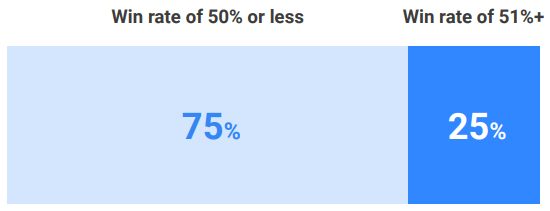
What was your approximate win rate on bids in 2024?
0 %
is the average percentage of subcontractors that win bids more than half of the time.

Subs Who Account For Working Capital Win More of Their Bids

Including the cost of working capital in bids not only has a tangible effect on profitability—It is a common feature of winning bids. Almost a third of subcontractors who include this cost reported winning bids more than half the time, compared to less than 1 in 5 subcontractors who don’t.
0 %
of subcontractors who typically include the cost of working capital in their bids reported winning bids more than half the time
0 %
Just 19% of subcontractors who rarely or never account for the cost of working capital reported winning bids more than half the time

10

Planning and Goal Setting

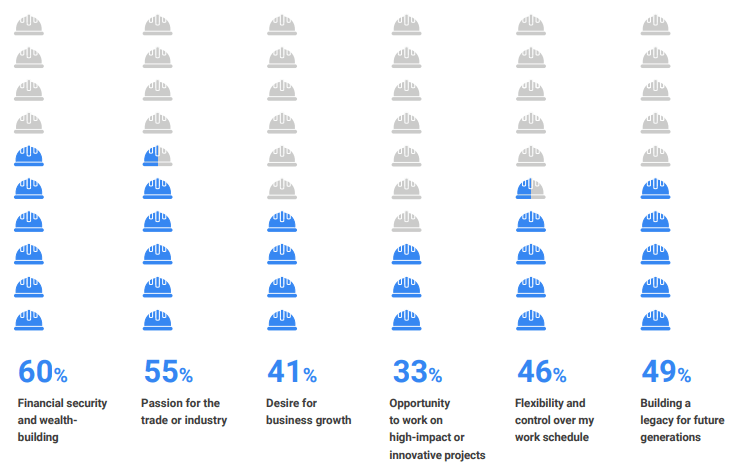
The motivations behind owning a subcontracting business are diverse and multifaceted, reflecting both personal and professional aspirations. The survey revealed a mix of drivers that inspire individuals to become and persevere as commercial subcontractors, as well as diversity in the types of goals these owners hope to accomplish in the future.
What motivates you to own a subcontracting business?

0 %
Financial security and wealthbuilding
0 %
Passion for the trade or industry
0 %
Desire for business growth
0 %
Opportunity to work on high-impact or innovative projects
0 %
Flexibility and control over my work schedule
0 %
Building a legacy for future generations

Subcontractors’ Goals

Which of the following goals do you have for your business in the next 5-10 years?

0 %
Increase my margins
0 %
Upskill employees or invest in training
0 %
Increase personal earnings
0 %
Add new services or expand offerings
0 %
Sell or cash out of the business
0 %
Leave the business to my children

What types of projects are you most interested in bidding on over the next year?

0 %
Larger-scale projects
0 %
Private sector projects
0 %
Smaller projects
0 %
Government contracts

Placing Their Bets for Growth

The outlook around business growth remains optimistic year over year.

0 %
of subcontractors’ business revenue grew in 2024, down from 67% in 2023 and 61% in 2022*
0 %
of subcontractors plan to grow their businesses in 2025, up from 73% in 2024
0 %
of subcontractors are interested in going after larger projects in 2025, up from 57% in 2024

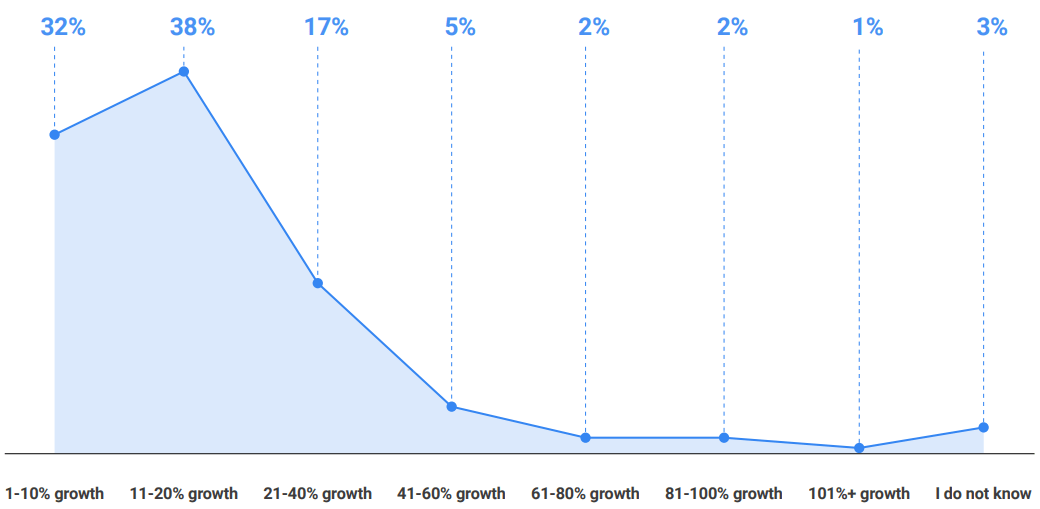
For subcontractors who saw revenue growth, we asked them by how much:

How Margins Compare to Last Year

0 %
The average annual profit reported by subcontractors
0 %
said their business was more profitable in 2024 than 2023, down from 55% who said their business was more profitable in 2023 than 2022

How Subcontractors Will Leverage Their Capital Options for Growth

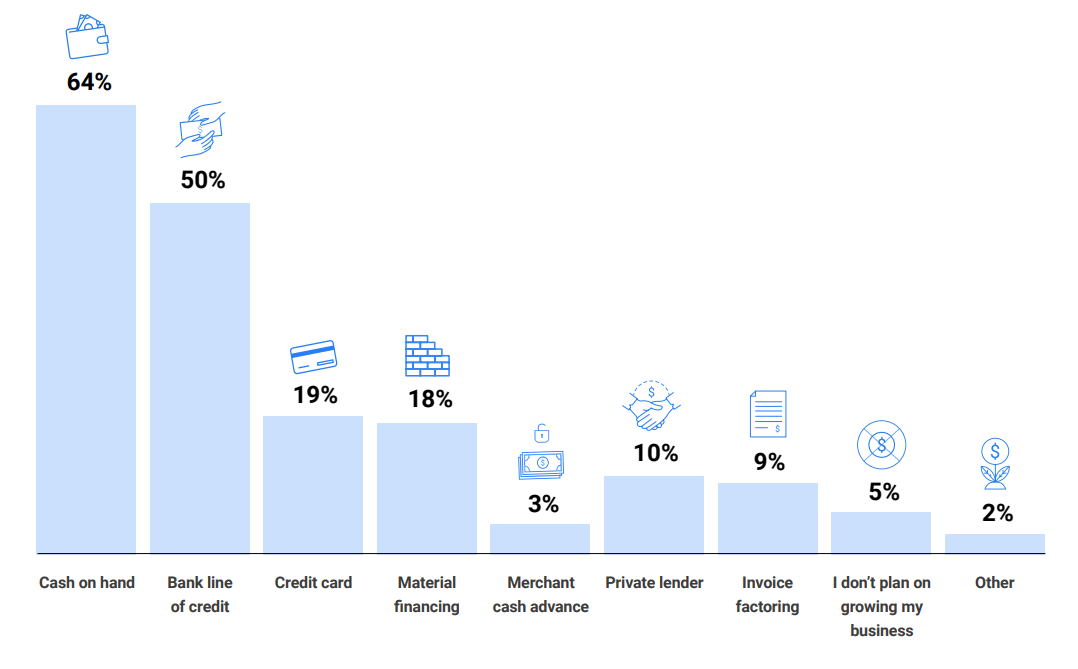
How do you intend to finance or support new business growth?

64%
Cash on hand
50%
Bank line of credit
19%
Credit card
18%
Material financing
3%
Merchant cash advance
10%
Private lender
9%
Invoice factoring
5%
I don’t plan on growing my business
2%
Other

How They Will Stay Competitive

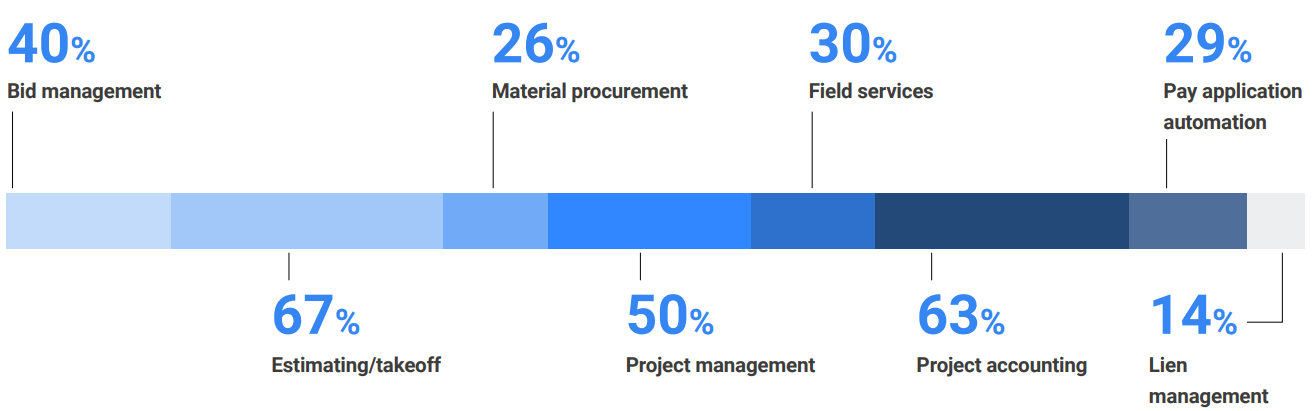
What construction technologies and software does your company use?

An Industry Veteran's Perspective

Chris Doyle Founder & CEO, Billd

The 2025 National Subcontractor Market Report paints a picture we already know: there is a long-standing structural flaw in the way subcontractors are paid in commercial construction.

This year, the report sheds light on the disconnect between the GC and subcontractor about how they view the problem. When polled, GCs put the average DSO at 30, while subcontractors report 56 days on average. More troubling is that subcontractors don’t know if payment will come on day 30 or day 56. The only thing predictable is that payment for subcontractors’ work is unpredictable. This forces them to take a new approach to working capital. Their best solution: a proactively-planned capital strategy.

In the report you’ll see the benefits of one particular proactive practice: leveraging multiple sources of working capital AND accounting for them as real project costs. Subs who factor working capital costs in their bids see 41% greater profitability. It’s a number we can’t celebrate enough. That can be the difference between surviving and thriving, between stagnation and growth. And the best part? They’re winning more bids too.

As the Champion of the Sub, Billd has made it our mission to shine a light on the severity of the problem and offer proof that there are solutions. Subcontractors have been forced to capitalize their businesses through options that simply do not give them enough capacity to work around 56-day payment— including 30-day supplier terms and using retained profits to overcome the working capital gap. They’re actively combatting the unpredictable cycle rather than applying their capital and efforts towards growth.

Thankfully, we talk to subs daily who are taking a strategic approach to working capital in order to combat the effects of poor cash flow, unlocking profitability and sustainable growth. Our hope is that this report can help subs of all sizes make a change—whether that’s implementing a whole new capital strategy from scrat

About Chris

Christopher Doyle is an entrepreneur and business leader with extensive construction and finance industry experience. He is the co-founder and CEO of Billd, a disruptive payment solution for the construction industry that helps subcontractors grow their businesses with less hassle and risk. Recognizing the cash flow hurdles that contractors face, Doyle launched Billd to make traditional Wall Street working capital accessible to business owners in the construction industry.

About Billd

Billd stands alone as a partner that truly champions the subcontractor. Their financial and payment products empower subcontractors to bypass project hurdles by providing access to upfront funds to cover their most pressing costs, including materials and labor. Unlike traditional financing outlets, Billd provides flexible lines of credit to accommodate the unpredictability of cash flow in construction, and extends their customers up to 120-day terms to align with industry payment standards. Billd knows traditional credit metrics are poor predictors for risk and has built a variety of industry-specific, proprietary analytic and financing tools to allow subcontractors to stabilize cash flow and more effectively grow their businesses.
11

About the Survey Respondents

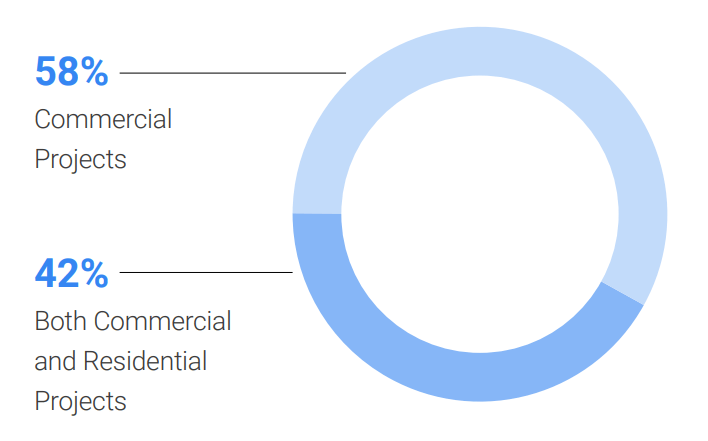
What kind of projects does your company primarily work on?

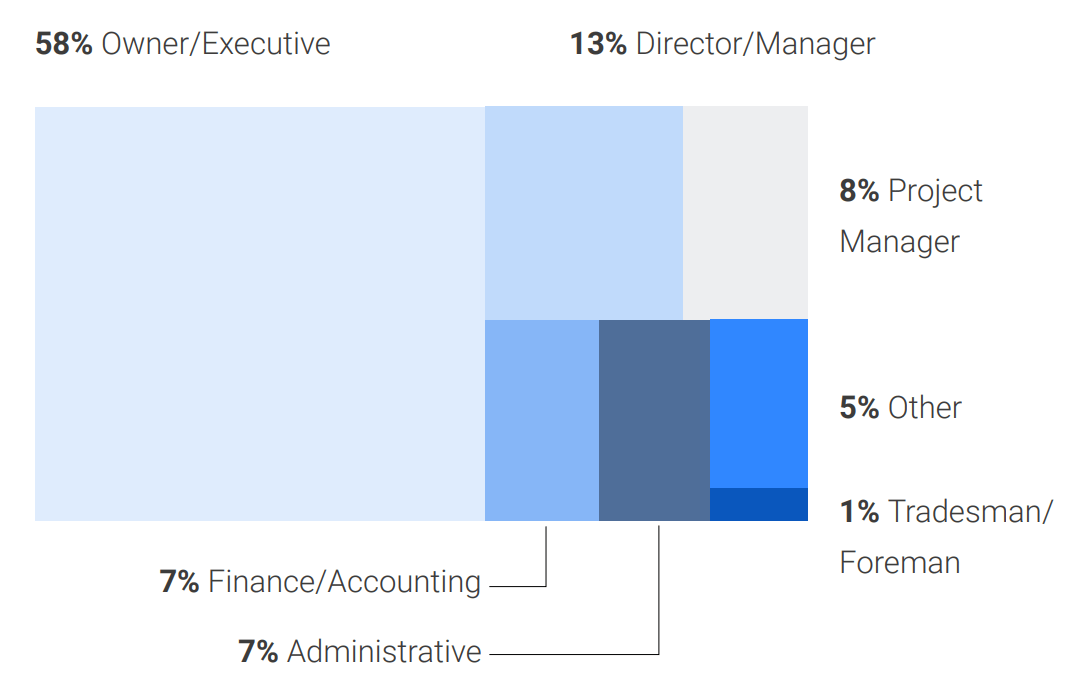
What is your role in the company?

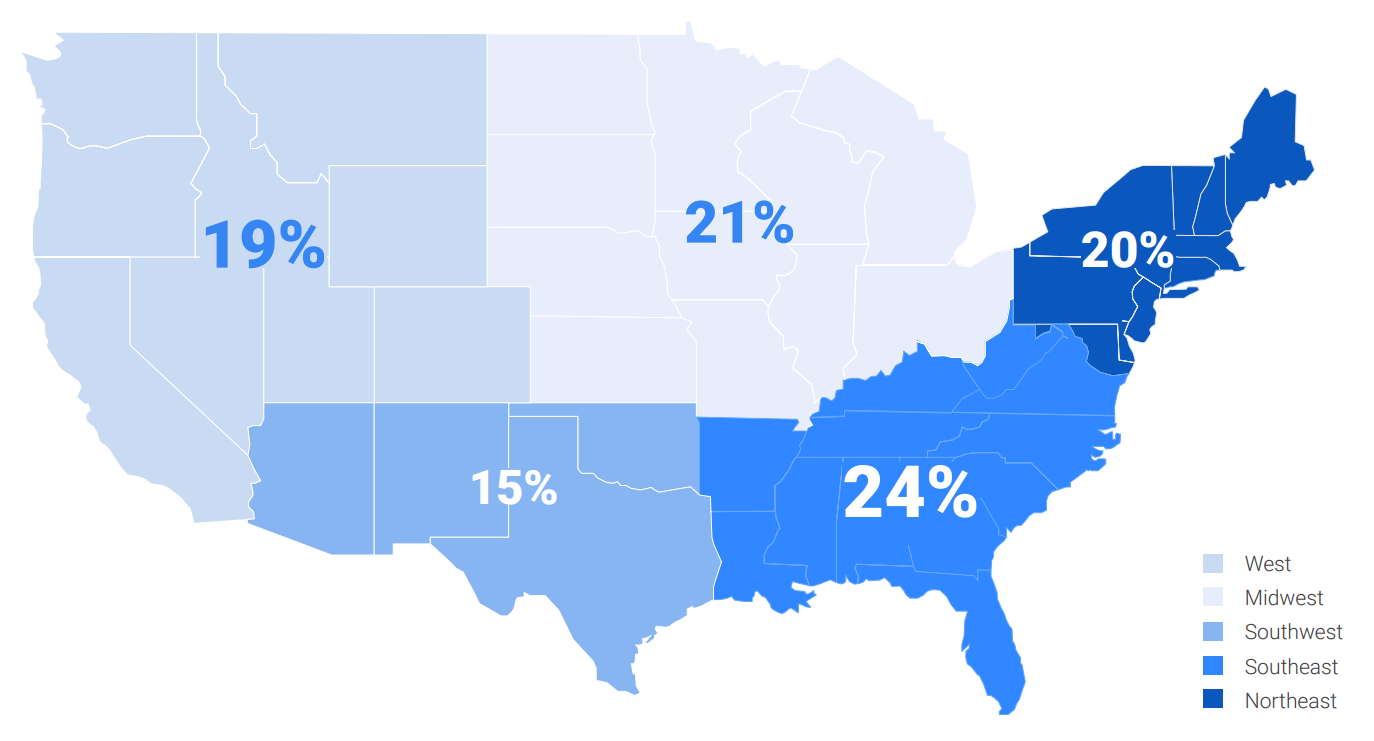
Which region does your company primarily work in?

How long has your company been in business?

0 %
5 years or less
0 %
5 -10 years
0 %
More than 10 years

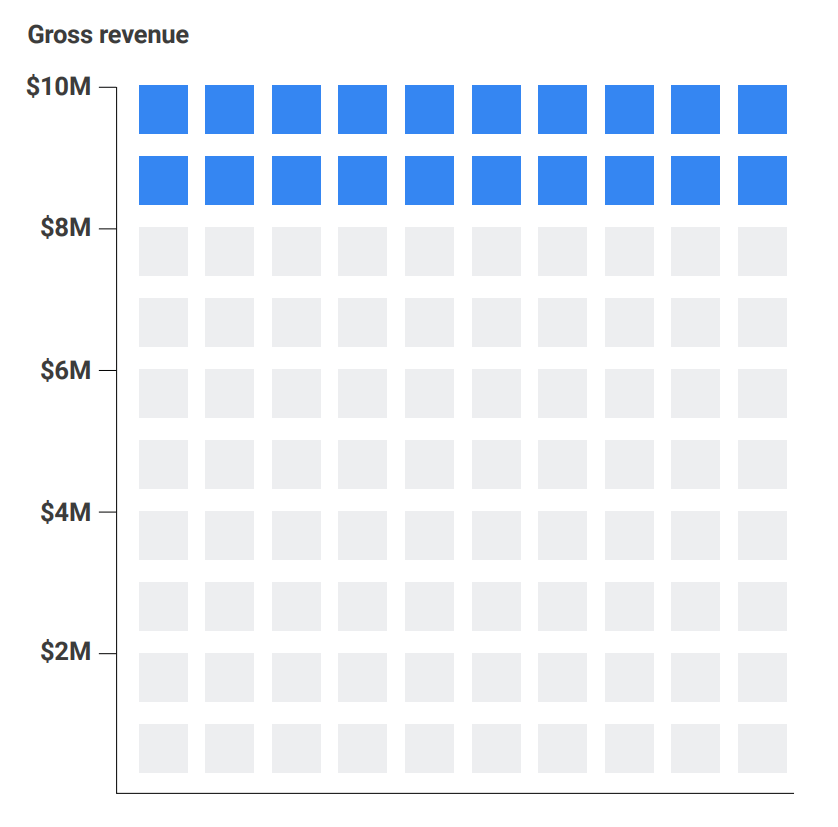
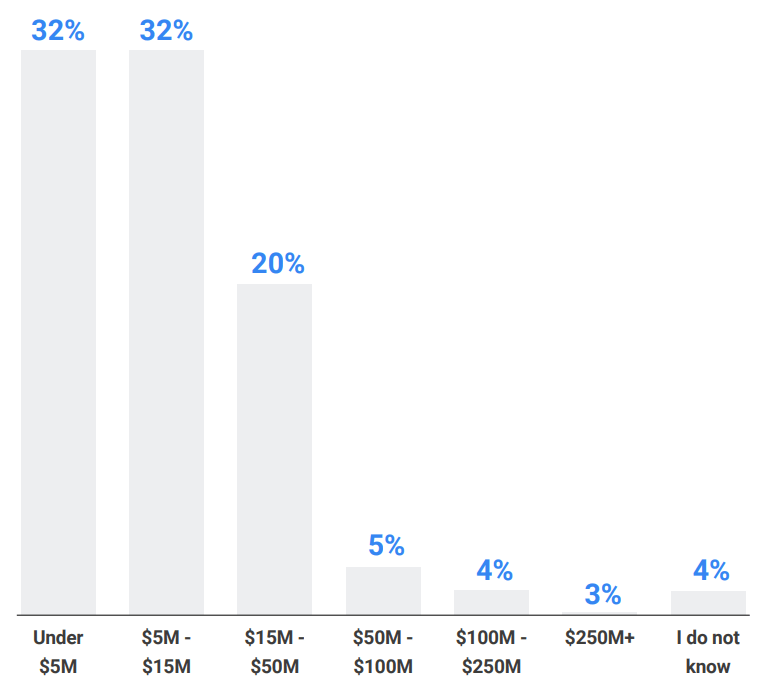
How much revenue will your company finish 2024 at?