

In sectors like retail and manufacturing, early pay programs have evolved into an essential, standard lever for capturing supply chain margin. And while the construction industry has been slower to adopt this model, general contractors are beginning to see the value.
Looking back, early pay programs emerged in response to a common challenge across industries: How can companies manage the timing of payments between those who buy goods and services, and those who provide them?
Understanding the history of early pay programs highlights how their recent adoption in construction addresses two long-standing problems simultaneously:
- They create significant returns for the general contractor.
- They help subcontractors accelerate payment timelines, reducing working capital pressure that slows production and increases project risk.
For GCs, this combination is attractive because timely payments can improve their subcontractors’ financial position, which can help keep projects on track. For subcontractors, it reduces the burden of covering upfront labor, materials, and payroll expenses for extended periods while waiting on payment—creating a win-win for subcontractors and GCs.
Compared to other initiatives GCs use to improve margins, early pay programs are simpler to operationalize and have less impact on established day-to-day workflows. All of these factors have made early pay programs one of the fastest-growing financial tools in construction.
To better understand how and why early pay programs have become more popular, let’s explore why they were first created, what’s changed, and how other industries used them prior to the construction industry’s adoption.
Table of Contents
The Early Days of Early Pay Programs
For many years, early pay programs were simple and buyer-funded. Buyers (companies that purchase goods or services and pay for them in an agreed-upon timeframe) would offer to pay suppliers (companies that provide goods or services to buyers) early in exchange for a fixed discount.
The structure was straightforward. 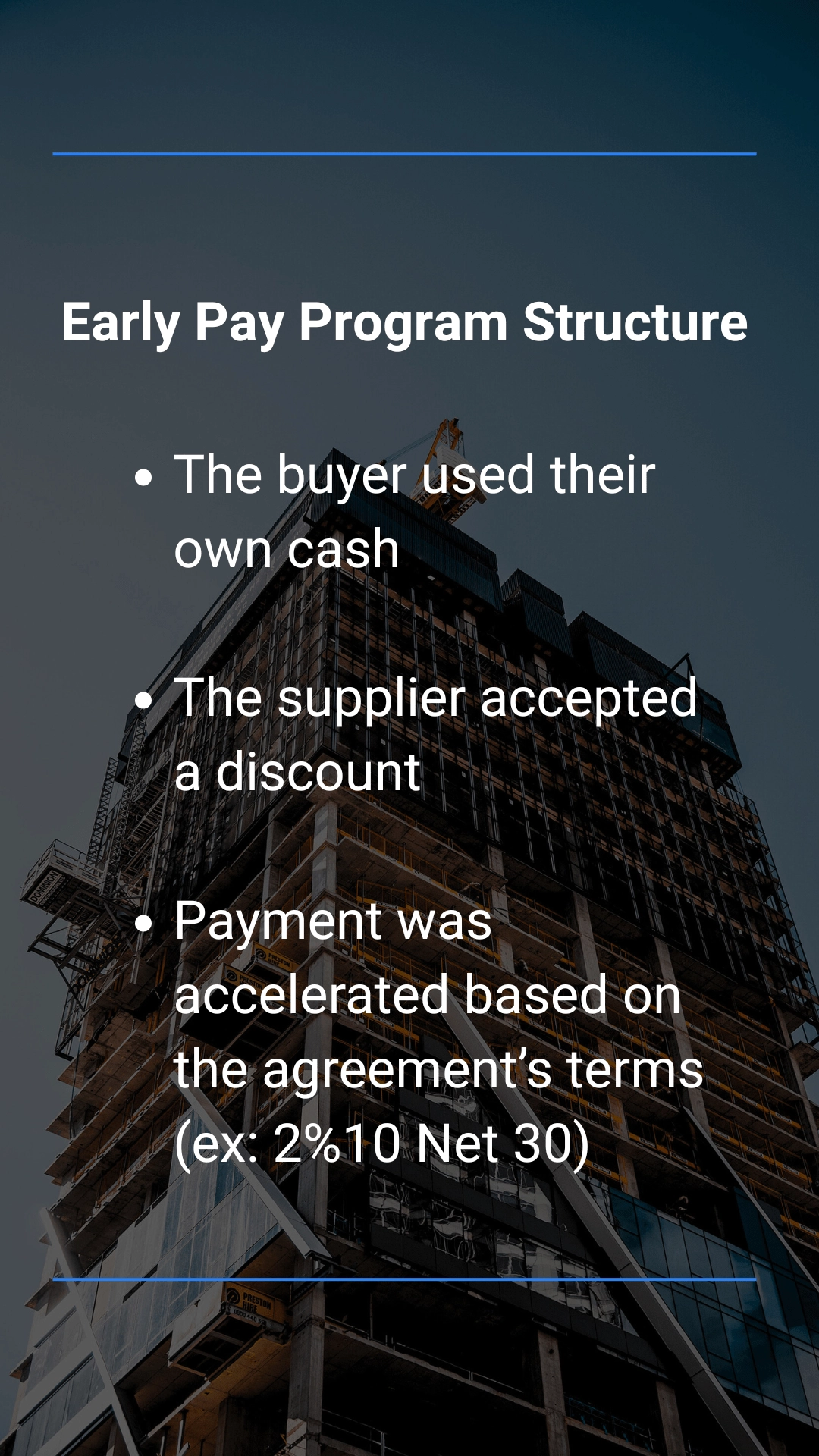
In this example, if the buyer pays the supplier in 10 days instead of 30, the buyer will take 2% off the invoice amount. There were many variations of payment terms, and these term arrangements were typically manual, one-off negotiations handled by email and managed by Accounts Payable departments, making it difficult to scale.
Even when the economics worked, early payment was limited by the buyer’s available cash and their ability to approve invoices in a timely manner. For the most part, early payment was treated as an exception rather than a formal program.
The First Wave of Technology
In the 1990s, early adopters began introducing technology to automate invoice approvals, improve visibility, offer discounts, and adjust payment timing. These platforms made early pay programs easier to manage operationally and allowed buyers to support more suppliers at once.
The introduction of dynamic discounting was a key driver of early adoption of these programs. Unlike a fixed discount, this approach offered a tiered schedule based on payment timing. For example, a buyer paying a supplier within 10 days might receive a 2% discount, while payment in 15 days would result in a reduced rate, such as 1.5%. While the specific model has evolved, this was a foundational concept of dynamic discounting.
Even with the technology improvements and dynamic pricing, the fundamental limitation persisted: The buyer remained the sole source of funding, and suppliers agreed that it took buyers too long to approve invoices. This resulted in low supplier participation because payment timing was unpredictable, depending entirely on buyer action, and the approval process was lengthy. While technology helped reduce some friction, it ultimately failed to unlock the program’s scale.
The Rise of Supply Chain Finance
In the early 2000s, a structural shift occurred with the introduction of third-party funded early payment programs, which became known as supply chain finance (SCF). These early supply chain finance platforms were built by fintech providers, and third-party funding initially came primarily from large global banks. Over time, banks began offering their own platforms that were either built internally or through partnerships with fintech providers.
A key innovation was the concept of a confirmed payable, which meant the buyer had contracted to pay an invoice (payable) for a specific amount on a specific date. Once confirmed, all commercial disputes remained between the buyer and the supplier. The funder relied solely on the buyer’s obligation to pay.
Here is how the process worked:
- Buyers uploaded approved invoices to a fintech platform (a challenge was still getting invoices approved fast)
- Suppliers logged in and viewed confirmed invoices
- Suppliers chose whether to receive early payment
- A third-party funder paid the supplier early electronically (no paper checks)
- The buyer paid the funder at maturity
This model solved three problems. First, the technology enabled automation and scale. Second, third-party funding removed the buyer’s cash constraint. Third, the confirmed payable meant the risk was solely on the buyer.
Why These Programs Took Off
Early supply chain finance programs initially gained traction as a way for buyers to earn incremental economic value without changing payment behavior. In their earliest form, these programs operated much like card payment programs. Suppliers that elected to receive early payment paid a fee and a portion of that fee was rebated back to the buyer. Buyers offered access to the program, suppliers opted in when it made sense, and the buyer earned a modest return. Another benefit of these programs was that the buyer was not borrowing from a third-party funder to pay suppliers; this was off-balance-sheet financing.
While useful, the financial impact of rebate-based programs was limited. The real acceleration occurred when buyers began using supply chain finance to extend payment terms.
Extending payment terms to suppliers—from 30 to 60 days, or 60 to 120 days—substantially raised buyers’ days payable outstanding (DPOs). This shift freed up capital for companies, often amounting to hundreds of millions of dollars. As a result, buyers were given a strong financial incentive to expedite invoice approvals.
Supply chain finance allowed buyers to extend terms while offering suppliers an alternative to waiting longer to be paid.
Suppliers were given a choice: They could wait until the new maturity date to be paid or they could elect to be paid early, often within 5 to 10 days after invoice approval, by discounting the invoice at attractive pricing.
Because the financing was based on the buyer’s credit risk rather than the supplier’s, pricing was very attractive. Rates were typically 1% to 3% above the base rate, translating to an annual percentage rate of approximately 1% to 8%, depending on the base rate (LIBOR and now SOFR) and the buyer’s creditworthiness.
This combination of extended terms for buyers and optional, low-cost early payment for suppliers drove widespread adoption. Buyers unlocked significant cash flow metrics and suppliers retained control over payment timing. The introduction of platforms and funders made the model scalable.
By the mid-2010s, supply chain finance had become a standard commercial practice across many industries worldwide. In North America, companies such as Walmart, Lowe’s, Ford, Nissan, Caterpillar, Boeing, Kellogg’s, Whirlpool, Target, and hundreds of others had rolled out programs.
Early Pay Programs in Construction
In the early 2010s, boutique financing firms entered the market to compete with banks for funding. These firms brought in liquidity from both bank and non-bank sources, including institutional investors, and sought to expand supply chain finance beyond traditional investment-grade buyers.
One of these firms was Greensill Capital. Greensill identified construction as an industry with a clear working capital imbalance. Subcontractors carried long payment cycles, while general contractors were under pressure to manage cash and keep projects moving.
In 2015, Greensill Capital partnered with Textura to create one of the first large-scale third-party-funded early pay programs for the construction industry. The initial approach mirrored traditional supply chain finance, extending payment terms and funding suppliers. This model changed the landscape.
Within two years, many of the largest general contractors in the United States launched early pay programs using third-party funding models. The combination of Textura’s invoice workflow platform and Greensill’s funding and program services created a solution that could scale quickly.
However, construction proved to be different from other industries. Paid-when-paid structures and regulatory requirements limited the ability to extend subcontractor terms. As a result, the model evolved. Early pay programs in construction shifted away from term extension and toward rebates and hybrid funding structures. General contractors could use their own cash when available and rely on third-party capital when it was not. This approach preserved flexibility while still delivering value.
What Happened When Greensill Collapsed
Greensill’s financial issues were unrelated to construction and tied to events in its other business lines. However, when Greensill failed, the construction industry suddenly lost the primary financial provider and servicer supporting early pay programs.
This created a market void. The technology platforms supporting early-pay workflows remained in place, and the value proposition for both GCs and subs remained strong. But there was no large-scale funder or servicer to help provide outreach to subs to join these programs.
As a result, some early pay programs shut down. Others continued to use their own cash or the GC’s bank lines of credit, creating a simple arbitrage between the cost of the line and the early-pay fees paid by subs. These approaches worked but were limited in scope and could not support broad adoption. In this model, the GCs were now responsible for the entire program.
While the loss of Greensill slowed momentum, it did not change the underlying value.
Why Early Pay Programs Are Growing Again in Construction
In other industries, early pay and supply chain finance programs have shown strong interest and ongoing deployments. In fact, most Global 2000 companies offer early pay programs to their suppliers.
While the need never diminished in construction, the options to solve the problem were limited. Interest in early pay programs in construction has accelerated over the past 24 months, driven by increased margin pressure for GCs and the significant financial strain on subcontractors over the last several years. Several macro trends are driving renewed demand:
- Higher interest rates have raised the cost of carrying work
- Material costs have increased over the last several years
- Labor costs have risen along with workforce shortages
- Commercial construction volumes have grown
- Cash flow challenges are now a top strategic risk for GCs
To address this demand, several early pay programs have been introduced to the construction industry. New technological platforms have entered the market, aiming to solve the unique challenges faced by both GCs and subcontractors. These programs now range from traditional early pay programs to card programs. The reality is that if you want to offer an early pay program, limited options are no longer the challenge.
The Inflection Point
Early pay programs have become a standard way to address working capital challenges between buyers and suppliers across many industries globally, including manufacturing, retail, food and beverage, consumer goods, and more. In each of these sectors, early pay evolved from a niche financial tool into a widely accepted commercial practice.
Construction now sits at a similar inflection point.
Subcontractors face increasing financial pressure from long payment cycles, rising labor and material costs, and limited access to affordable capital. Waiting to get paid is no longer a neutral condition. It carries a real and growing financial cost. General contractors are looking for ways to strengthen project performance, reduce risk, and generate incremental returns and improve margins without adding operational complexity.
Early pay programs are emerging as a practical solution that addresses both sides of this equation. By connecting general contractors and subcontractors through a shared financial mechanism, early pay programs help mitigate systemic cash flow strain that has long existed in construction. At the same time, the construction industry has moved well beyond manual, paper-based payment processes. The adoption of digital workflows, standardized pay applications, and electronic payments has created the foundation to support early pay programs at scale.
This combination of factors explains why early pay programs are gaining momentum in construction. They combine favorable economics, reduced risk, and relatively simple implementation at a moment when the industry is ready to adopt them. General contractors now have multiple early pay solutions to address these challenges, setting the stage for broader adoption across the construction ecosystem.
Looking for more information on GC Early Pay? Check out A Guide to General Contractor Early Pay Programs: What They Are & How They Work